
Enterprises don’t fail at AI because they lack vision. They fail because vision collapses the moment it has to touch reality.
In workshops and early deployments, that collapse happens fast. Once teams are given a real AI operating system—one that can actually connect systems, enforce governance, and execute actions—the conversation changes almost immediately. The whiteboard ambitions fade. The hypotheticals disappear. What remains is a simple, uncomfortable question: what do we build first, knowing it has to work?
What teams build first when it HAS to work
The answer is almost never glamorous. Teams don’t start with autonomous strategy engines or omniscient copilots. They start with the work that is loud, repetitive, and visibly broken. Ticket intake that leaks context. Reconciliations that consume entire teams every month. Approval chains that exist only because no one trusts the data upstream. These are not visionary use cases. They are structural ones.
This is not a failure of imagination. It’s a recognition of constraint. When teams know they are building on a shared operating system—rather than stitching together another pilot—they optimize for durability. They choose problems that are narrow enough to ship, painful enough to justify change, and frequent enough to prove value quickly. The result is a set of early implementations that look almost boring from the outside, but transformative from the inside.
The hidden cost of the first build
What’s really interesting is how fast their posture changes once the first few builds are live. The initial implementations are almost always workflow-centric. Deterministic. Step-based. Safe. But something subtle happens as soon as those workflows are running inside a real platform rather than a brittle stack of scripts and integrations.
Teams start to notice that the hardest parts of the build weren’t the logic—they were the prerequisites:
Connecting to systems of record
Establishing permissions
Defining what the AI is allowed to see, do, and decide
Encoding guardrails so that automation doesn’t become liability
These are the costs that dominate the first build, regardless of the use case. And once they’re paid, they don’t need to be paid again.
The first AI implementation is expensive because you’re not solving a use case — you’re installing the system that makes future use cases cheap.
When workflows quietly become agents
When data is already unified, actions are already abstracted, and governance is already enforced centrally, adding reasoning on top becomes the easiest part of the system. Teams stop asking how to automate each step and start asking where humans are still unnecessarily in the loop.
The early value from this shift is not dramatic in isolation. Cycle times shrink. Error rates fall. Humans are removed from work they never wanted to do in the first place. No one rings a bell because revenue didn’t instantly double. But structurally, something important has happened: the organization has built leverage instead of another artifact.
Why early wins compound instead of plateau
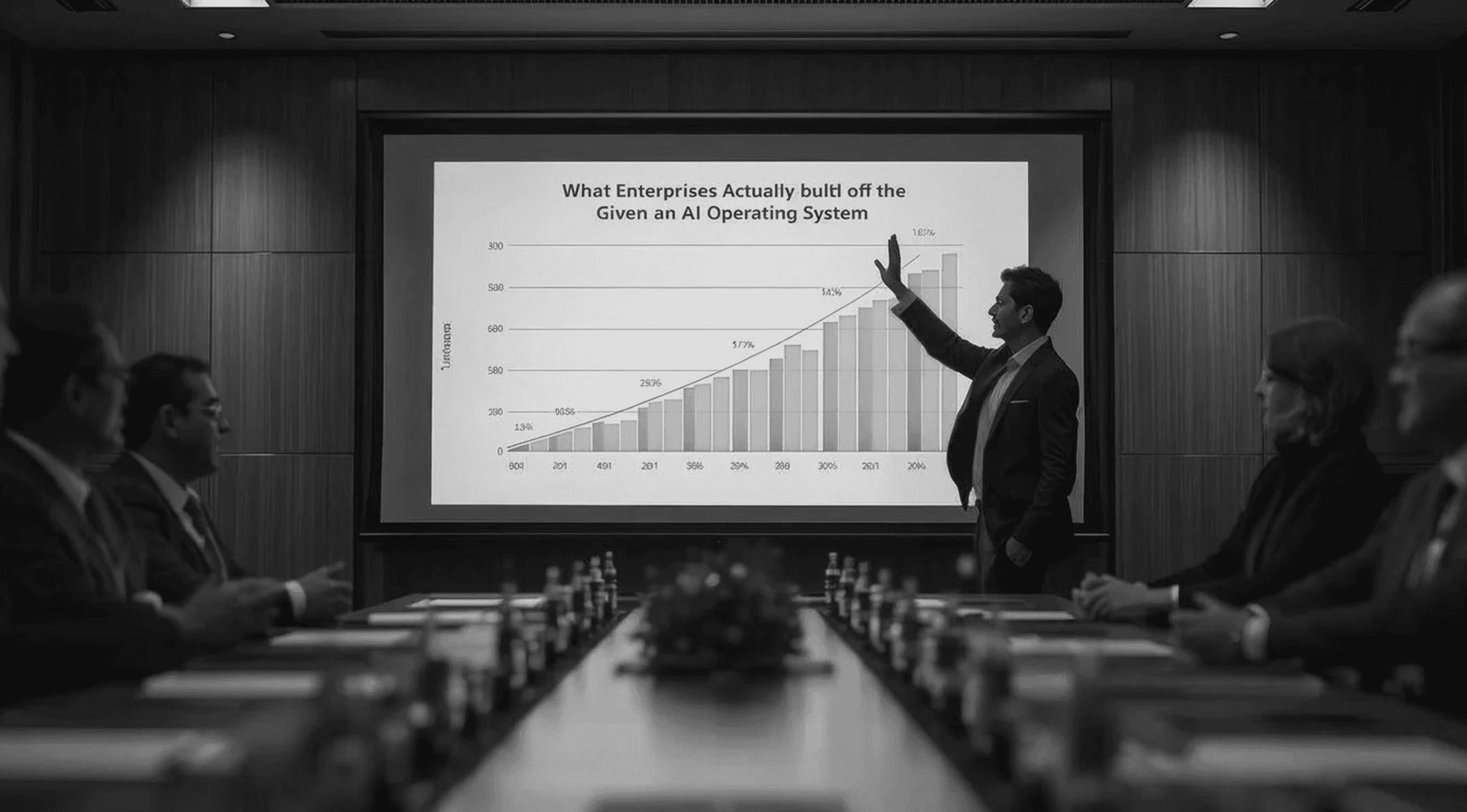
This is where many AI narratives go wrong. They obsess over the size of individual wins and miss the shape of progress. The real advantage of an AI operating system is not that it produces one breakthrough application. It’s that it changes the cost curve of building the next one.
After the first few implementations, teams stop treating AI initiatives as bespoke projects. Integrations are already there. Permissions are already modeled. Governance is inherited rather than reinvented. The question is no longer “Can we connect to this system safely?” but “Do we want this agent to act automatically or escalate?” That is a fundamentally different design problem.
At this stage, reuse becomes the default. Not reuse in the abstract sense of “best practices,” but concrete reuse of components that already exist inside the platform. A data model defined for finance becomes relevant to procurement. An approval pattern built for HR is reused in IT. An agent that reasons over exceptions in one domain becomes a template for others. The organization is no longer building use cases; it’s assembling capability.
When things start getting easier
Just as important is what stops happening. Teams stop spending time debating which model to use for every new idea. They stop rebuilding the same connectors. They stop negotiating governance from scratch with every stakeholder. Those decisions move down into the operating system, where they belong. What remains at the surface is intent: what outcome do we want, and how much autonomy are we comfortable granting?
This is the moment when AI adoption stops feeling like a series of experiments and starts behaving like infrastructure. Progress accelerates not because people are working harder, but because the marginal cost of building drops sharply. The second agent takes half the effort of the first. The tenth takes a fraction. Eventually, building a new agent feels closer to configuration than construction.
Enterprises that never reach this phase often misdiagnose why. They blame organizational resistance, regulatory fear, or lack of talent. In reality, they are trapped in a structural loop: every new idea requires rebuilding the same foundations, so ambition becomes expensive. Teams become cautious not because they lack confidence in AI, but because they’ve learned that every pilot comes with hidden tax.
The unexpected power curve of AI
An AI operating system concentrates the hard work upfront and amortizes it across everything that follows. That’s why the first implementation always feels heavy. You are not just solving a problem; you are building the conditions under which future problems become easy.
This is also why enterprises that get this right begin to diverge so quickly from their peers. From the outside, it can look like sudden acceleration—more agents, more coverage, more autonomy in less time. From the inside, it feels almost mundane. The system is there. The patterns are known. The question is no longer whether something can be built, but whether it’s worth building now.
AI transformation doesn’t stall because enterprises run out of ideas. It stalls because each idea is treated as if it’s the first. The quiet power of a real AI operating system is that it ensures it never is.