
Quick Answer
Most enterprise AI initiatives stall because data is fragmented, workflows are spread across applications, and governance arrives late, so every new AI initiative becomes a one-off effort. UnifyApps brings an AI Operating System that unifies enterprise knowledge, actionability, and governance into a single architecture. Happiest Minds brings deep expertise in generative AI, digital engineering, cloud, and enterprise modernization. Together they offer enterprises a path from strategy and use case identification to production-grade deployment, managed services, and measurable ROI tied to cycle time reduction, productivity gains, and revenue acceleration.
key Takeaways
The bottleneck is the environment, not the model. Most enterprises are trying to scale AI on systems never designed for it: fragmented data, disconnected workflows, governance applied after something breaks. Every new initiative rebuilds integrations, recreates context, and re-applies controls. That's why organizations stay stuck in pilot mode.
The market conversation is shifting from tools to systems. Point solutions and copilots generate insight but leave execution to humans navigating disconnected systems. The UnifyApps and Happiest Minds partnership is focused on moving AI from alongside workflows to across them, with governance built into the foundation.
CIO angle: governance embedded in the architecture, not layered on afterward. The current model of deploying disconnected AI tools multiplies integration complexity and governance overhead with every use case. A unified AI layer means orchestration and control are structural, not operational debt.
CDAO angle: the bottleneck has shifted. Most enterprises already have the data, the models, and the insights. What's missing is the ability to act on them consistently, at scale, across the business. AI that triggers workflows and completes tasks is the difference between dashboards and outcomes.
Enterprise AI is not short on momentum.
Across industries, organizations are investing heavily in Generative AI. Pilots are live. Copilots are being deployed. Teams are experimenting with agentic workflows. On the surface, it looks like real progress.
But step back, and a different pattern emerges. Very few of these initiatives are making it into production at scale. Even fewer are delivering measurable, enterprise-wide outcomes.
The issue isn’t the models. It’s the environment those models are expected to operate in.
The Scaling Problem No One Talks About
Most enterprises today are trying to scale AI on top of systems that were never designed for it.
Data is fragmented across platforms. Workflows are spread across applications. Governance is introduced late—often after something breaks. In that environment, AI has no consistent foundation to operate on.
So every new initiative becomes a one-off effort. Integrations are rebuilt. Context is recreated. Controls are re-applied. What starts as innovation quickly turns into operational friction.
This is why so many organizations remain stuck in pilot mode. Not because AI doesn’t work—but because it doesn’t connect.
A Shift From Tools to Systems
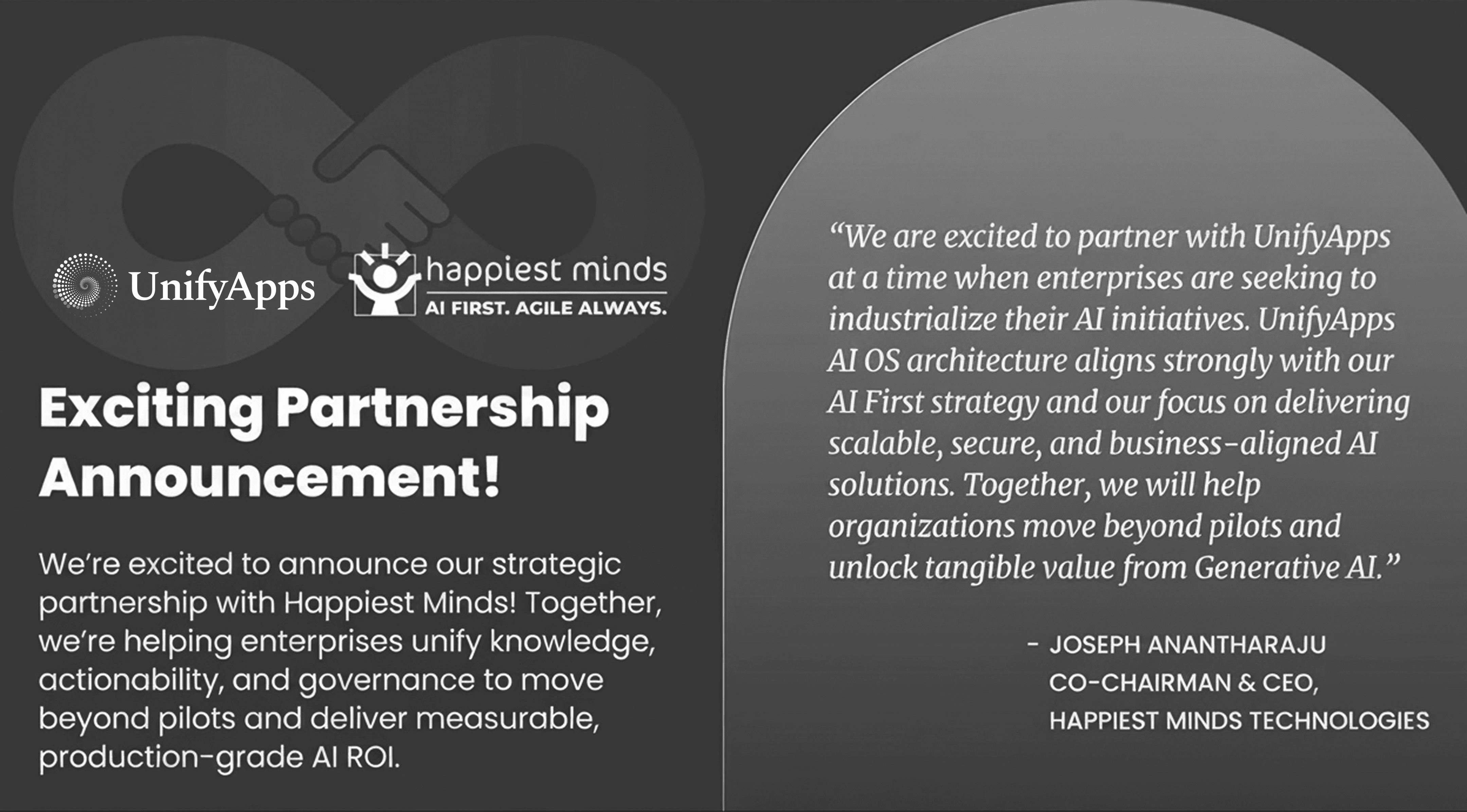
The partnership between UnifyApps and Happiest Minds Technologies reflects a broader shift happening in the market.
The conversation is moving away from models and point solutions—and toward systems.
UnifyApps brings an AI Operating System designed to unify enterprise knowledge, actionability, and governance into a single architecture. Happiest Minds brings deep expertise in generative AI, digital engineering, cloud, and enterprise modernization.
Together, they are enabling enterprises to move beyond experimentation and toward production-grade AI deployments that are secure, scalable, and tied to real business outcomes.
What’s Actually Different Here
Most AI initiatives today stop at insight.
They generate recommendations, surface patterns, and provide visibility. But execution still depends on humans navigating disconnected systems to act on those insights.
This partnership is focused on closing that gap.
By unifying systems into a single execution layer, AI can operate across workflows—not just alongside them. Agents can coordinate actions across applications, with governance and controls built into the foundation rather than layered on afterward.
That shift—from insight to execution—is where enterprise value is created.
CIOs: This Is About Control, Not Capability
For CIOs, the challenge isn’t access to AI. It’s control.
How do you scale AI across hundreds of systems without increasing risk, duplicating integrations, or losing visibility?
The current model—deploying disconnected AI tools—makes that harder. Each new use case introduces more complexity, more governance overhead, and more operational risk.
What’s different in this approach is that governance, interoperability, and scalability are embedded into the architecture itself. The system is designed to orchestrate AI across workflows while maintaining control across the enterprise.
CDAOs: Insight Is No Longer the Bottleneck
For CDAOs, the bottleneck has shifted.
You already have the data. You already have the models. You already have insights.
What’s missing is the ability to act on them—consistently, at scale, across the business.
That’s where a unified AI layer changes the equation. Instead of insights sitting in dashboards, AI can trigger workflows, complete tasks, and drive measurable outcomes tied to real business processes.
This is the difference between experimentation and impact.
The Market Is Optimizing the Wrong Layer
There’s a broader point here.
The industry is over-optimizing models and under-investing in systems.
Models will continue to improve. That’s inevitable. But without a way to unify data, workflows, and governance, even the most advanced models will remain underutilized.
The real bottleneck is not intelligence.
It’s orchestration.
From AI Ambition to Measurable Outcomes
The UnifyApps and Happiest Minds partnership is designed to address that bottleneck directly.
By combining an AI-native platform with implementation expertise, enterprises gain a path from strategy and use case identification to deployment and managed services.
The focus is not experimentation—it’s operationalization. Delivering measurable ROI tied to cycle time reduction, productivity gains, and revenue acceleration.
The Bottom Line
Enterprise AI is entering a new phase.
The winners won’t be the organizations running the most pilots. They’ll be the ones that turn AI into something operational—something that runs across the business, not beside it.
That requires more than better models.
It requires a system.
And increasingly, that’s where the market is heading.
What is the UnifyApps and Happiest Minds Technologies partnership?
A strategic partnership that combines UnifyApps' AI Operating System, which unifies enterprise knowledge, actionability, and governance into a single architecture, with Happiest Minds' expertise in generative AI, digital engineering, cloud, and enterprise modernization. Together, they give enterprises a path from AI strategy and use case identification through to production-grade deployment, managed services, and measurable ROI tied to cycle time reduction, productivity gains, and revenue acceleration.
How does UnifyApps help enterprises move from AI pilots to production?
By providing the foundation that pilots typically lack. Most enterprise AI initiatives stall because data is fragmented, workflows are disconnected, and governance is applied after something breaks, so every new initiative rebuilds integrations and recreates context from scratch. UnifyApps' AI Operating System addresses all three: a unified knowledge layer for shared enterprise context, a standardized actionability layer so agents can execute across systems, and governance encoded into the architecture rather than bolted on after deployment.
What is the difference between AI insight and AI execution?
Most enterprise AI today stops at insight: generating recommendations, surfacing patterns, and providing visibility through dashboards. Execution still depends on humans navigating disconnected systems to act on those insights. AI execution means agents can trigger workflows, complete tasks, and coordinate actions across applications directly, closing the loop between signal and outcome. That shift is where enterprise ROI is actually created.
Why do enterprise AI pilots fail to reach production at scale?
Because the environment they move into wasn't designed to support them. Data is fragmented across platforms. Workflows are spread across applications. Governance arrives late. In that environment, every new AI initiative becomes a one-off effort, integrations rebuilt, context recreated, controls re-applied. The problem compounds with scale: each new use case adds integration complexity and governance overhead rather than drawing on shared infrastructure. The fix is an architecture where the second deployment is easier than the first and the tenth easier than the second.