
In this article
- Quick Answer
- Key Takeaways
- AI Native Across the Enterprise
- Strategy & Leadership: Escaping the Chatbot Era
- Knowledge & Context: The Foundation of Trusted Digital Workers
- Operations: From Reactive Work to Governed Flow
- Supply Chain & Manufacturing: From Dashboards to Autonomous Coordination
- Technology & Architecture: From Code‑First to Assembly‑First
- Governance: The New Currency of Enterprise AI
- How Leaders Should Think About Sequencing
Quick Answer
Most enterprise AI is stuck in what theCUBE Research calls "The Chatbot Trap": conversational pilots that answer questions but can't complete work. The real question, as Scott Hebner frames it, is no longer whether AI can talk, but whether it can think, act, and deliver ROI. Trusted digital workers require more than a language model: they need senses (connections into enterprise systems), memory (factual, episodic, and procedural across sessions), context (knowledge graphs reflecting real enterprise logic), conscience (governance, guardrails, auditability), and actions (safe, governed execution). UnifyApps unifies these layers through three non-negotiable contexts: Data and Knowledge, Governance, and Actionability.
key Takeaways
The Chatbot Era is ending. AI-native leaders have moved from responding to reasoning, from conversation to execution, and from probabilistic answers to governed autonomy: employees evolve from admins of systems to governors of digital workers.
LLMs are only the brain. Trusted digital workers require a full cognitive system: senses into enterprise data, persistent memory across sessions, knowledge and context graphs, governance guardrails, and safe actionability: all unified below the agent layer.
This is an enterprise-wide operating model shift, not an AI team initiative. Every function is built on repeatable decision loops; AI-native enterprises embed agents into those loops so decisions become faster, more consistent, and economically disciplined.
Sequencing matters. Start where financial impact is measurable, the workflow already exists, humans spend disproportionate time reconciling systems, and governance gaps create risk.
Based on a conversation between theCUBE’s Scott Hebner and UnifyApps’ Roland Boulos
Enterprises have spent the last year racing to deploy copilots, chat interfaces, and FAQ‑style assistants. Yet while industry surveys show that 45% of enterprise leaders are actively planning next‑generation AI agents, most deployments remain stuck in conversational pilots — a gap driven by what theCUBE Research calls “The Chatbot Trap.” As theCUBE’s Scott Hebner frames it,
“the real question is no longer whether AI can talk — it’s whether AI can think, act, and deliver ROI.”
This blog reflects insights from both the live conversation between Scott Hebner and Roland Boulos, and Scott’s separate Executive Brief, which examines the broader architectural shift toward next‑generation agentic AI and positions UnifyApps as a leading example of that evolution.
Across industries, organizations are moving beyond conversational interfaces toward production‑grade digital labor — AI agents that can reason, remember, contextualize, and take governed action across systems.
AI Native Across the Enterprise
This shift is not an “AI team” initiative. It is a redesign of how the enterprise operates.
Every function — from finance to supply chain to customer operations — is built on repeatable decision loops. Today, humans manually reconcile context across disconnected systems. AI‑Native enterprises embed agents into these loops so decisions become faster, more consistent, and economically disciplined.
UnifyApps’ architecture enables this shift by unifying three non‑negotiable contexts:
Data & Knowledge Context — grounding agents in enterprise truth
Governance Context — enforcing policies, guardrails, and transparency
Actionability Context — enabling safe, reversible execution across systems
This is the foundation for scaling from experimentation to enterprise‑wide digital labor.
Strategy & Leadership: Escaping the Chatbot Era
Most organizations began with the same instinct: wrap ChatGPT, point it at a knowledge base, and deploy a widget. But as Roland notes, this only scratches the surface.
As Scott Hebner writes in the Executive Brief, “The Chatbot Era is ending.” AI‑Native leaders now focus on:
Reasoning, not responding
Execution, not conversation
Governed autonomy, not probabilistic answers
Employees evolve from admins of systems to governors of digital workers. Humans supervise, approve, and correct — while agents perform the work.
This is the new operating model.
Knowledge & Context: The Foundation of Trusted Digital Workers
LLMs are powerful, but they are only the brain. And enterprises are recognizing this fast: industry surveys indicate that roughly 44% of enterprises plan to invest in Knowledge Graphs over the next 18 months, signaling a decisive shift toward structural grounding, context, and governed reasoning.
As Scott emphasizes, “Knowledge and Context are the true differentiators.”
Enterprises need the rest of the cognitive system:
Senses → connections into SAP, Salesforce, ServiceNow, email, data lakes
Memory → factual, episodic, and procedural memory across sessions
Context → knowledge graphs + context graphs that reflect real enterprise logic
Conscience → governance, guardrails, access controls, auditability
Actions → safe, reversible, governed execution across systems
UnifyApps unifies these layers — enabling agents that don’t just answer questions, but complete work.
Operations: From Reactive Work to Governed Flow
Most enterprise workflows break because humans must manually stitch together context:
A pricing change underperforms
A contract stalls in legal
A supply chain signal is missed
A customer issue escalates
A compliance risk goes unnoticed
AI‑Native operations embed agents that continuously sense, reason, and act across systems — with humans in the loop for oversight.
This transforms operations from reactive queues into governed flows.
Supply Chain & Manufacturing: From Dashboards to Autonomous Coordination
One of the most compelling examples Roland shared is a Supply Chain Command Center powered by a team of AI agents:
A Demand Sensing Agent detects anomalies in POS data, weather, and news
A Contract Risk Agent identifies potential SLA breaches and penalties
An Inventory & Logistics Agent recommends rebalancing stock across warehouses
Humans supervise. Agents do the work.
The result: proactive prevention of revenue loss and real‑time operational agility.
This is digital labor in action — and it’s built on UnifyApps’ AI-Native architecture.
Technology & Architecture: From Code‑First to Assembly‑First
LLMs alone are not enough. In fact, industry analysts report that more than 60% of enterprises are already moving beyond conversational AI toward agentic architectures, reflecting widespread recognition that LLM‑only systems cannot meet enterprise reliability requirements.
As highlighted in the Executive Brief, LLM‑only architectures produce high error rates in regulated, domain‑specific environments, making governance, context, and memory non‑negotiable. Scott reinforces this shift, noting that “Persistent memory closes the architecture gap,” enabling agents to evolve from stateless assistants into continuously learning digital coworkers.
Enterprises need an AI Operating System — a horizontal platform that:
Connects systems and data
Builds unified knowledge + context graphs
Provides governed actionability
Orchestrates multiple LLMs
Enables assembly‑first agent development
Supports observability, auditability, and lifecycle management
This is exactly what UnifyApps delivers.
Governance: The New Currency of Enterprise AI
Trust is the defining theme of enterprise AI. As Scott notes, “trust is the currency of innovation and ROI.”
AI‑Native governance includes:
Identity, access, and policy enforcement
Guardrails and rollback paths
Observability and traceability
Multi‑agent orchestration governance
Cross‑platform agent governance (internal + external agents)
UnifyApps embeds governance into every layer — ensuring agents act safely, consistently, and transparently.
How Leaders Should Think About Sequencing
AI‑Native transformation is not achieved through disconnected experiments. It is built deliberately on a shared foundation.
Start where:
The financial impact is measurable
The workflow already exists
Humans spend disproportionate time reconciling systems
Governance and context gaps create risk
An AI‑Native enterprise is defined not by a single use case, but by how many decision surfaces are continuously monitored, reasoned upon, and improved by agents operating on a shared AI foundation.
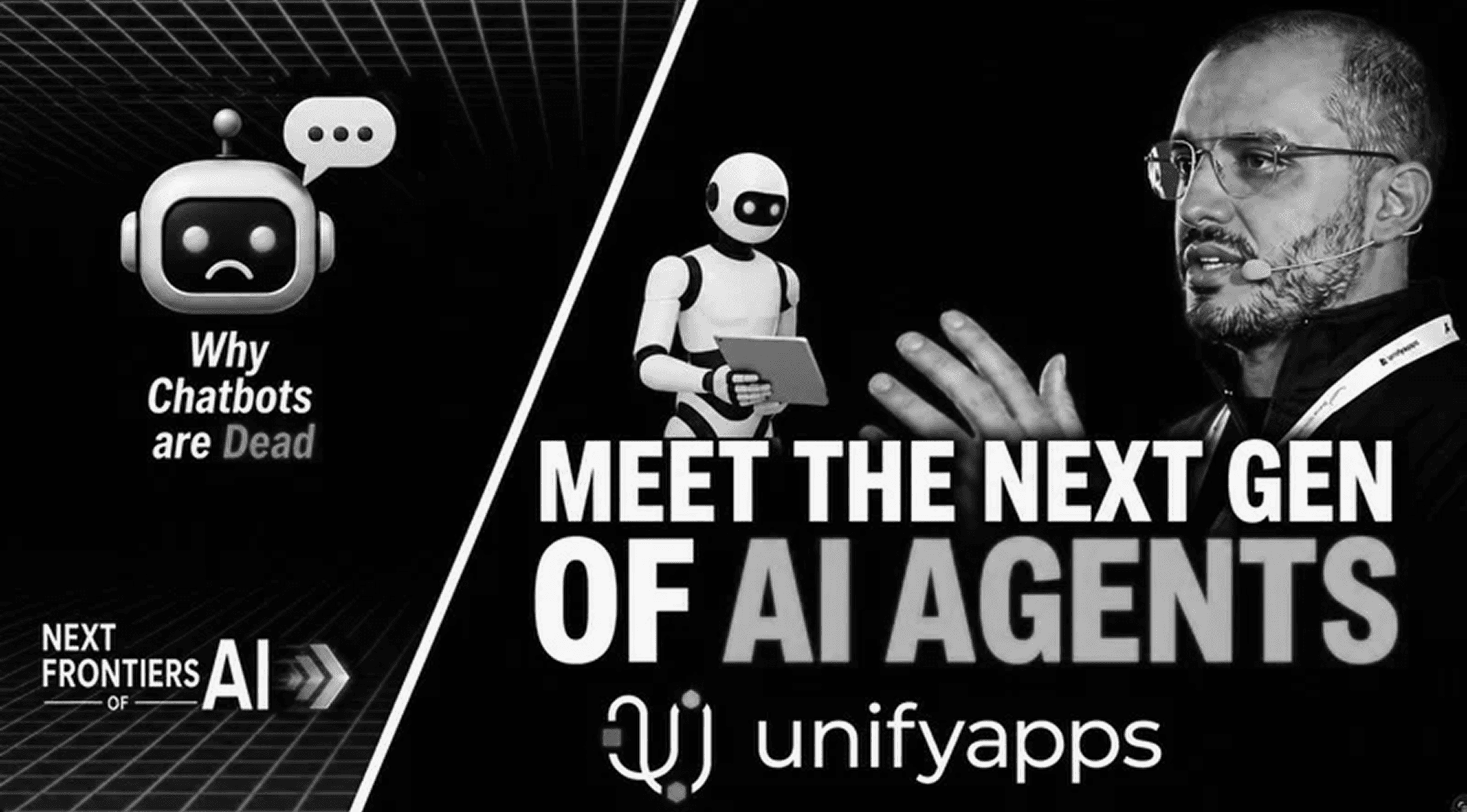
Listen to the full conversation, “Meet the Next Gen of AI Agents.”
Read the Executive Brief, “Next Gen of AI Agents That Know, Contextualize, and Remember.”