
Scope an agent to one action, and trust what it does.
Keep each agent to a single discrete action inside the workflow — the kind of step that can be reasoned through and executed without a person. Small scope is what makes autonomy safe to grant.

Test it in isolation Prove one action against real cases before it touches production. Narrow scope means a clear pass mark, not a vague sense that the automation "mostly works".

Reuse it everywhere Call the same agent from any workflow in any department. Verify a vendor once, and every process that needs it inherits the behaviour, the logging and the guardrails.

Replace it without fallout Swap the model, the prompt or the whole approach behind a step as cost and capability shift. Defined inputs and outputs keep everything around it untouched.
Follow one agent through a single decision, start to finish.
Watch the same agent handle a refund request end to end: pull the evidence, reason over it, check itself against its confidence threshold, then either act — or hand the call to a person. Switch the scenario to see both endings.
Retrieve
Pull the order, the policy clause and the customer's history through connected systems.
Interpret
Read the unstructured ticket thread and extract what actually happened.
Decide within bounds
Apply the refund policy inside its scope, spend limit and confidence threshold.
Write back
Execute through the governed API gateway — the agent never holds the credential.
Escalate to an app
Route to a human-in-the-loop screen with the evidence attached, whenever confidence falls short.
retrieve order #51997, refund policy §4.2, customer history + 3 systems
Build custom agents for any level of organizational complexity
Pin down behavior before it runs
State the agent’s role, its goal and its inputs in plain language — so its scope is explicit, reviewable by the business owner, and impossible to drift from run to run.
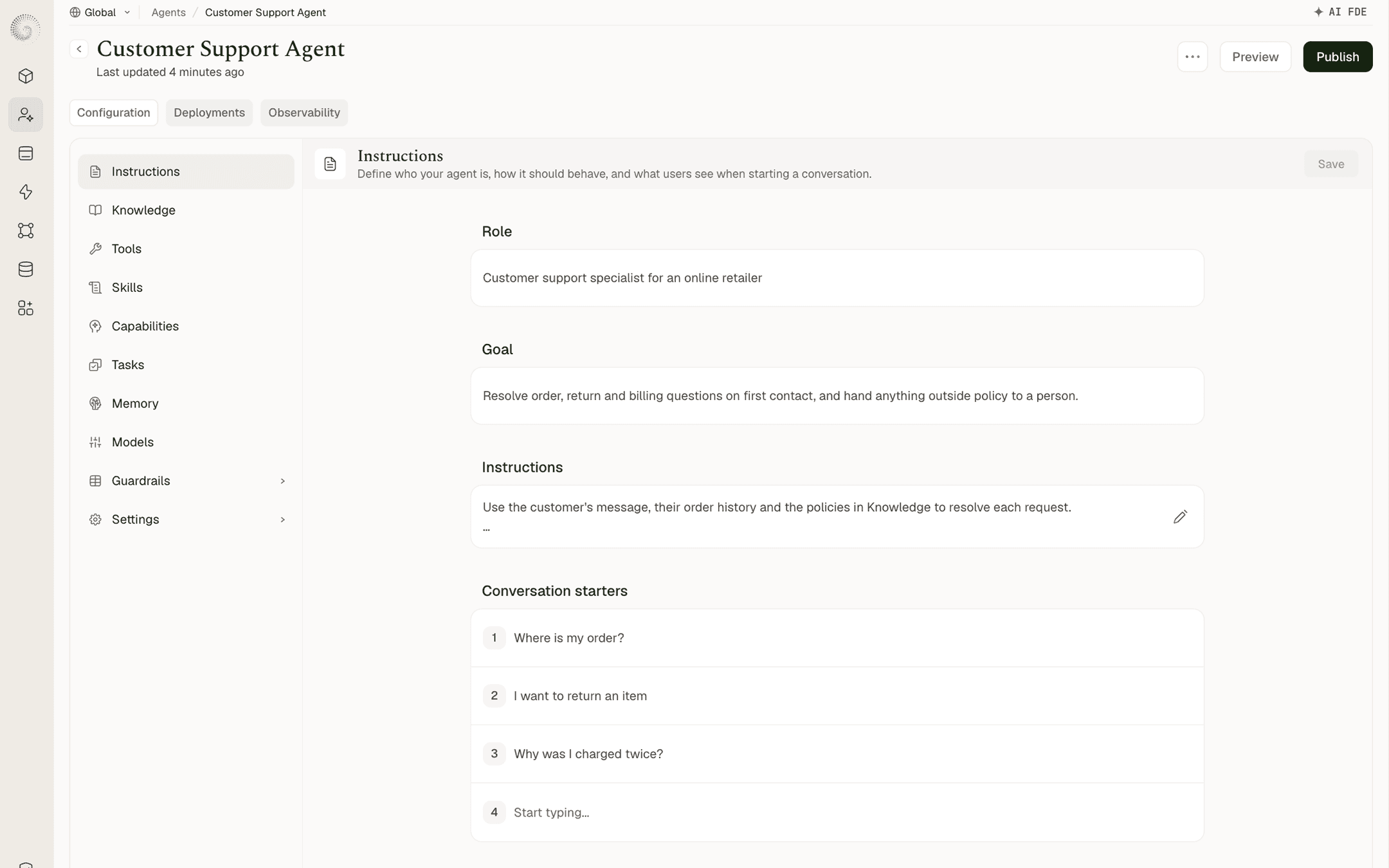


Grant your agents autonomy within the limits you set.
Define what an agent may touch, spend and decide before it runs. Everything outside those bounds routes to a person instead of guessing.

Point agents at documents, tickets and email threads — the material rules-based automation could never read — and get structured decisions back.

Every read and write routes through the governed API gateway. Agents request the action; the platform decides whether it is allowed and logs the result.

Set the systems in reach, the budget per run and the confidence an agent must clear before it commits anything.

Choose from 50+ models per step — a cheap one for bulk parsing, a strong one for judgment — and change your mind later without editing the workflow.
Put agents to work like an extra team, running around the clock.
Give agents one step at a time and you see it in the numbers you already track: how long work takes, how often it goes wrong, and how much of the day people spend copying information between systems.
 Cycle time
Turn 10–15 days into 4 hours Supply-chain replenishment planning ran end to end in a single afternoon, with 80% less manual effort behind it.
 Onboarding
Close verification in under an hour Banking onboarding and verification cycles that took multiple days now finish inside the first customer session.
 Accuracy
Lift reconciliation to 99% Automated reconciliation replaced an 85% manual baseline — fewer exceptions to chase downstream.
 Screening
Cut review time by 70–95% Government document review dropped 70%; CV screening in recruitment pipelines dropped 95%.
 Productivity
Reclaim 2–3 hours a day One conversational surface across 1,000+ applications removes the context-switching between inboxes, portals and calendars.

Put a swarm of agents on one task this month — governed and routed to people when it matters. Then the next.
Security & Compliance
Industry-leading security and privacy standards.


