

In this article
- Quick Answer
- Key Takeaways
- A look at how Cooper Consumer Health is taking AI from pilot to production: it starts with the business problems that matter most, proves value in the field and then scales with one governance model for every agent.
- Cooper has grown from €200 million to more than €1 billion in a decade. Where did that growth make information hardest to turn into action?
- Where is AI already part of daily work and what has it changed for your field sales teams? Any directional impact?
- How do you keep AI accountable to the business as it moves beyond the first use case?
- What does an AI-native operating model mean at Cooper, and how far do you want to take it?
- Many enterprises have plenty of AI pilots and little value to show. What would you tell leaders earlier in their journey?
- What becomes possible once agents connect knowledge across the whole company?
Quick Answer
Augustin de Beaurepaire, Chief E-Commerce Officer and Executive Sponsor for AI at Cooper Consumer Health, explains how Cooper is moving AI into the daily work of its field sales teams. An AI agent now prepares each pharmacy visit brief, and reps using it have grown must-stock-list distribution by more than 20 percent. Every agent passes the same approval gates, with a business owner and a business case tied to the function’s P&L.
key Takeaways
Anchor pilot to production around business problems. Start with the problems that matter most, prove value on a few use cases, then scale.
Build the Enterprise Brain across functions. Connect each department’s knowledge through agents so anyone can draw on it when they need it.
Govern every agent the same way. One set of approval gates, a business owner and a P&L-tied business case for each.
A look at how Cooper Consumer Health is taking AI from pilot to production: it starts with the business problems that matter most, proves value in the field and then scales with one governance model for every agent.
Excerpt from our conversation with Augustin de Beaurepaire, Chief E-Commerce Officer and Executive Sponsor for AI, Cooper Consumer Health.
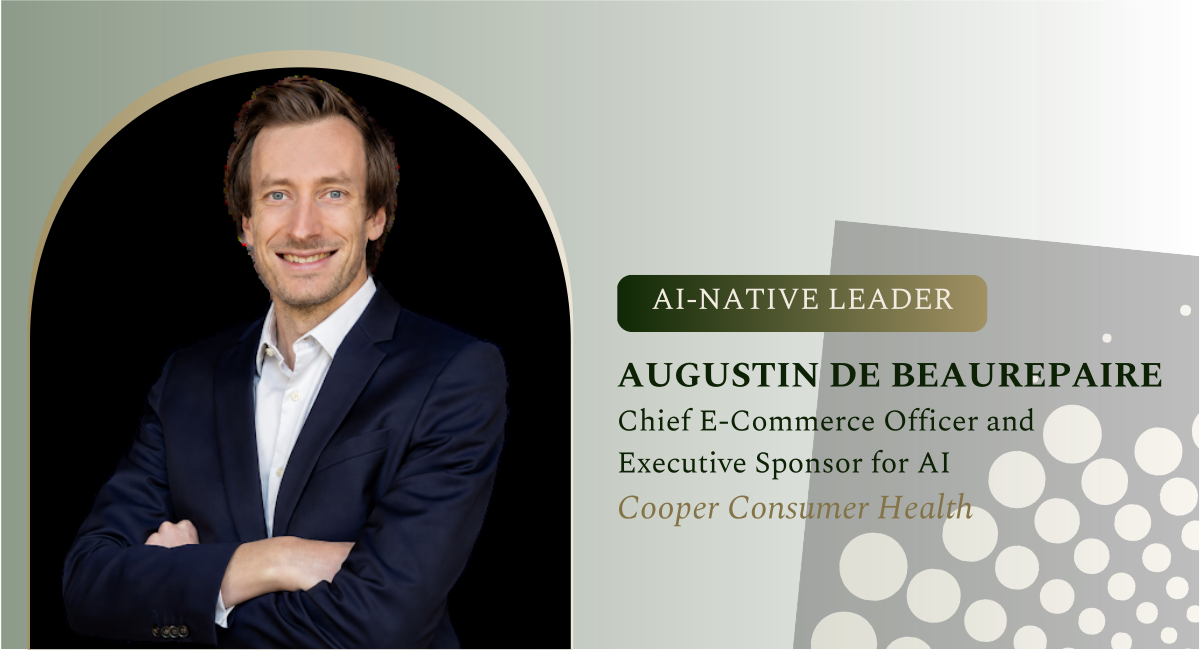
"If you start from the technology, you end up with a lot of pilots and very little value."
Cooper has grown from €200 million to more than €1 billion in a decade. Where did that growth make information hardest to turn into action?
Cooper Consumer Health has changed scale in about ten years, growing from around €200 million (US $230 million) in revenue to more than €1 billion (US $1.15 billion) both organically and through acquisitions. That growth has brought more brands, more countries and more affiliates, and with them a lot more operational complexity.
Access to information is not really our problem. Turning it into action is. In many roles, people can spend up to 80% of their time collecting and consolidating data, checking it and building presentations. That leaves around 20% for what matters: deciding and acting.
We want AI to flip that ratio. We want roughly 20% of the time spent preparing a decision, with AI doing the gathering and the synthesis, and 80% spent deciding and delivering results.
Where is AI already part of daily work and what has it changed for your field sales teams? Any directional impact?
The clearest example today is pharmacy visit preparation for our field sales teams. Before seeing a pharmacist, a sales rep needs a clear picture of that outlet: order history, contract terms, assortment gaps, current promotions. Until recently, building that picture meant pulling data by hand from several systems and reconciling it before every single visit.
Now an AI agent prepares that brief, including a recommendation on what to prioritize, and the rep reviews it and decides. Reps walk in with a clear plan and spend the visit talking with the pharmacist rather than on admin. That is exactly what we want AI to do at Cooper: take complexity off our people so they can put their expertise where it counts, with our customers.
The results are very encouraging. Our number one objective is to increase the distribution of our must-stock list, and the reps using the agent have grown their must-stock-list distribution by more than 20%.
How do you keep AI accountable to the business as it moves beyond the first use case?
The biggest shift is that AI is now seen as a business priority, not an IT project. Leaders are starting to look at it through their own challenges: where time gets lost, where decisions are slow, where work is repetitive.
The first use case also showed us that adoption cannot be imposed. The reps did not just receive a new tool. They adopted it because it helped them in their day-to-day work, and that made all the difference.
We also put discipline around it from day one. Every agent goes through the same approval gates, with a business owner and a business case tied to the function’s P&L. Adoption of our approved AI tools is an important early signal, but it is not the goal in itself. What we track is the impact on sales, productivity and quality, use case by use case. In the long run, success means AI being as natural at Cooper as email or Excel.
What does an AI-native operating model mean at Cooper, and how far do you want to take it?
For me, an AI-native company is one where AI is built into how people work, decide and create value, rather than added on top as one more tool.
I often talk about creating “super employees”: people who spend less time on repetitive work, decide faster with better information and focus on what really moves the business. If we can make our teams 30, 40 or even 50 percent more productive, that is what will allow Cooper to keep growing without our costs and our complexity growing at the same pace.
We have more than 1,500 employees, and our ambition is to give every one of them the chance to work this way.
Many enterprises have plenty of AI pilots and little value to show. What would you tell leaders earlier in their journey?
Quite simply: AI is not an IT topic, it is a business topic.
Start with your most important business problems, then work out where AI can change the outcome. If you start from the technology, you end up with a lot of pilots and very little value.
The technology is now mature enough. Large language models have become far more powerful and reliable, and platforms like UnifyApps make it possible to connect them to your enterprise systems and turn them into real business use cases quickly.
So this is the moment to accelerate, but with focus. Pick a small number of use cases that matter, prove the value, then scale.
What becomes possible once agents connect knowledge across the whole company?
The next step is scaling what we have started, with more agents and more countries. But the real prize is bigger than that. Like most companies, we have knowledge split across departments, each with its own data, its own tools and its own way of working. What excites me is connecting all of it through agents, so that someone in marketing can draw on what operations knows, and someone in operations can see what our consumers and pharmacists are telling marketing. The whole company’s knowledge, available to anyone who needs it, at the moment they need it.
This matters even more for a company like Cooper, which has grown through many acquisitions. Once we have one agentic strategy across the group, integrating a new business becomes much faster and smoother: its teams connect to the same agents and the same shared knowledge as everyone else, instead of a patchwork of systems.
That is the company I want us to build. One where people spend their time thinking, deciding and creating, not searching for information. AI is going to change the way we work, and for the better. And I am convinced it will be the main driver of our growth in the years ahead.