

In this article
- Quick Answer
- Key Takeaways
- Beyond the pilot — building the foundation to put enterprise AI to work.
- What operational challenges were you trying to solve when you set out to modernize your enterprise AI foundation?
- Where has AI become operational across the organization, and where is it showing up most visibly?
- What has changed since you began building this enterprise AI foundation?
- How do you think about the operating model of an AI-Native enterprise, and is that where you’re steering the organization?
- What would you tell enterprise leaders who are earlier in their AI journey?
- What capability or outcome are you most excited to unlock next?
Quick Answer
Pankaj Mishra, Executive Vice President & Head, Enterprise Technology Group, describes how Sony Pictures Networks India is moving beyond isolated AI pilots by building a secure, reusable foundation that connects enterprise knowledge, data, applications and workflows. Its AI initiatives span employee productivity, business operations and content decisions, with permissions, monitoring and human approval built into the approach from the start.
key Takeaways
Move from isolated use cases to a reusable foundation. Pankaj is connecting enterprise knowledge, data, applications and workflows so AI initiatives can share architecture, connectors and security controls.
Design for production from day one. Accuracy, permissions, auditability, monitoring, cost attribution and human approval are requirements from the outset, not steps to add after a pilot.
Put AI where it improves work and decisions. Initiatives span an enterprise assistant for trusted information, operational workflows such as sales deal creation and executive reporting, and analysis that brings together ratings, streaming performance, social listening and research.
Beyond the pilot — building the foundation to put enterprise AI to work.
Excerpt from our conversation with Pankaj Mishra, Executive VP & Head, Enterprise Technology Group at Sony Pictures Networks India
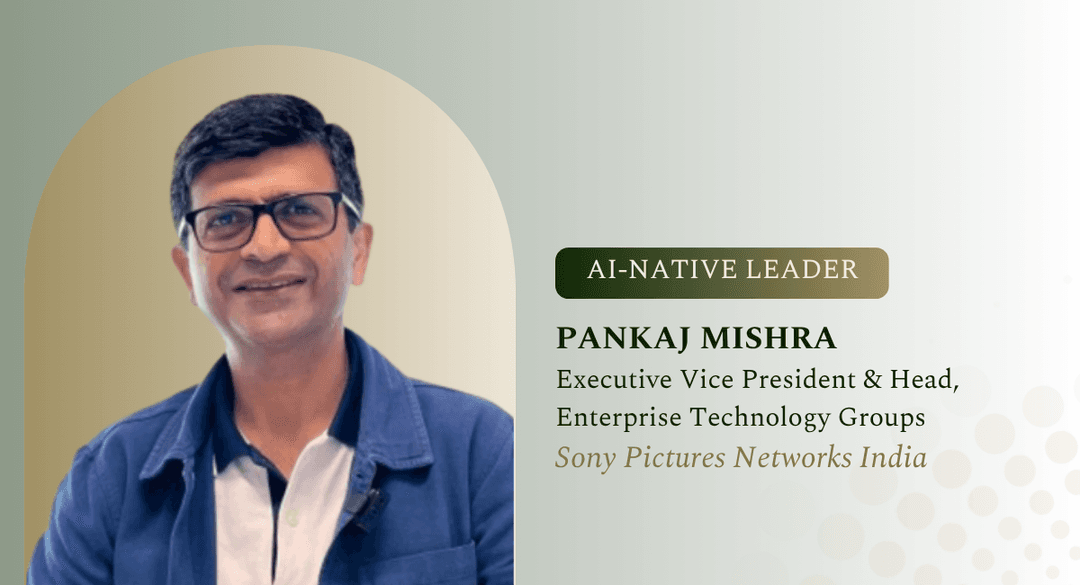
“We are moving beyond pilots toward reusable architecture, connectors, security controls, evaluation, observability and deployment disciplines that can support multiple business use cases."
What operational challenges were you trying to solve when you set out to modernize your enterprise AI foundation?
Our starting point was not AI for its own sake. We wanted to break information silos, reduce manual effort, and make knowledge, insights and actions accessible through one interface. Too much time was being spent searching across systems, reconciling data and navigating fragmented workflows instead of focusing on business outcomes.
We therefore set out to build a secure, common AI foundation connecting enterprise knowledge, data, applications and workflows. The objective was to move from isolated use cases to a governed platform where AI can help people find trusted information, generate insights, automate work and progressively execute multi-step processes while respecting existing access rights.
Where has AI become operational across the organization, and where is it showing up most visibly?
AI is becoming operational where it can deliver visible enterprise value: employee productivity, business operations and the media value chain.
Our Enterprise AI Assistant is creating a secure, common interface to trusted enterprise knowledge across collaboration, CRM, finance, distribution and internal systems, helping employees find answers, summarize information and move toward workflow automation within existing permissions.
In operations, agentic AI is reducing manual effort in areas such as sales deal creation and executive reporting, with a focus on faster turnaround, better quality and governed execution.
In the media value chain, AI is helping connect ratings, OTT performance, social listening and research to explain performance drivers and support sharper content decisions.
Together, these initiatives show AI moving from pilots to practical value delivery: improving how people work, how leaders decide and how content teams create impact.
What has changed since you began building this enterprise AI foundation?
The biggest change is that the conversation has moved from “What can AI do?” to “How do we operationalize it safely, repeatedly and at scale?” We are moving beyond pilots toward reusable architecture, connectors, security controls, evaluation, observability and deployment disciplines that can support multiple business use cases.
Business participation has also increased. Through enablement sessions and our internal AI hackathon, colleagues across functions are converting real operational bottlenecks into prototypes, helping AI move from centralized experimentation to broader organizational capability.
Most importantly, we now design for go-live from the outset, with accuracy, permissions, auditability, monitoring, guardrails, cost attribution and human approval treated as core solution requirements.
How do you think about the operating model of an AI-Native enterprise, and is that where you’re steering the organization?
For me, an AI-native enterprise is not one where every process has a chatbot. It is an organization where data, knowledge, applications and workflows are designed so intelligence can be embedded into decisions and actions. We are some distance from that aspiration, but it is the direction we are steering toward.
The operating model needs three layers: a governed enterprise platform for common integration, identity, security, data and AI capabilities; specialist agents that understand business domains; and clear human accountability through ownership, controls, monitoring and escalation paths.
The long-term goal is a federated model where technology teams provide architecture, controls and reusable components, while business teams co-create solutions closest to their work. Over time, specialist agents should collaborate under orchestration while staying within enterprise permissions and governance.
What would you tell enterprise leaders who are earlier in their AI journey?
Start with business friction, not the model. The best AI use cases come from processes where people spend time searching, reconciling, re-entering, summarizing or making decisions from fragmented information.
Design for production from day one. Leaders should think early about permissions, data quality, accuracy, monitoring, cost, auditability, ownership and human intervention because these determine whether AI becomes dependable enterprise infrastructure.
Finally, involve the people closest to the work. Technology teams must provide the secure foundation, but adoption accelerates when business users help identify, test and shape solutions, making AI an organizational capability rather than a specialist project.
What capability or outcome are you most excited to unlock next?
I am most excited about moving from assistants that retrieve and summarize information to an ecosystem of specialist agents that can reason across enterprise context, coordinate with one another and complete governed actions.
The aspiration is for an employee to ask one question and have the system securely bring together knowledge, data and business rules, generate insight, recommend action and initiate approved workflows without the user needing to know which system sits behind it. We are still some distance from that, but that is the direction.
In our industry, this can connect the full value chain: audience understanding, content decisions, fan experiences, monetization and enterprise operations. The real value is not just faster automation, but giving people more time for creativity, judgment and innovation while AI handles search, synthesis and routine coordination.