Cooper Consumer Health has grown from about €200 million to more than €1 billion in a decade. With that growth came more brands, countries and affiliates, and a widening gap between having information and acting on it. Augustin de Beaurepaire’s answer has been to bring AI into the daily work of Cooper’s field sales teams. An AI agent now prepares the brief for each pharmacy visit, and reps who use it have grown must-stock-list distribution by more than 20 percent. Cooper is scaling by focusing on its most important business problems, connecting knowledge across departments into an Enterprise Brain, and governing every agent the same way. Each agent passes the same approval gates and needs a business owner and a business case tied to its function’s P&L.



Cooper Consumer Health has grown from about €200 million to more than €1 billion in a decade. With that growth came more brands, countries and affiliates, and a widening gap between having information and acting on it. Augustin de Beaurepaire’s answer has been to bring AI into the daily work of Cooper’s field sales teams. An AI agent now prepares the brief for each pharmacy visit, and reps who use it have grown must-stock-list distribution by more than 20 percent. Cooper is scaling by focusing on its most important business problems, connecting knowledge across departments into an Enterprise Brain, and governing every agent the same way. Each agent passes the same approval gates and needs a business owner and a business case tied to its function’s P&L.

AI-Native Leader: Spotlight on Pankaj Mishra, Sony Pictures Networks India Sony Pictures Networks India is moving beyond isolated AI pilots by building the foundation for AI to operate across the enterprise. Its approach connects knowledge, data, applications, and workflows so AI can support employee productivity, automate operational processes such as sales deal creation and executive reporting, and improve content decisions using signals from ratings, streaming performance, social listening, and research. For Pankaj Mishra, becoming AI-Native requires more than adding assistants or deploying individual agents. It takes a horizontal enterprise foundation that provides shared context, integration, security, governance, observability, and controlled action from the start. SPNI is working toward a federated model where specialist agents can operate across that common foundation, collaborate across business domains, and take governed action while employees interact through a unified AI experience rather than navigating the systems and agents behind it.

The Enterprise Brain gives every AI agent one view of your business. Learn the five steps to build the knowledge, governance, and action layer.

AI-Native Leader: Spotlight on Santosh Bhilegaonkar, AMN Healthcare AMN Healthcare is taking a disciplined, ROI-first approach to AI agents and agentic automation, using digital labor to transform high-volume workflows across the enterprise. Early initiatives span timesheet processing, billing reconciliation, commission calculations, software development, and back-office operations, with the goal of shifting people from manual work to exception management and driving measurable EBITDA impact. For Santosh Bhilegaonkar, becoming AI-Native requires more than deploying individual agents. It takes business and IT co-ownership, clear KPIs, and a horizontal platform that can connect systems, context, governance, and action. With its Enterprise Brain strategy, AMN Healthcare is working toward a future where employees can access a unified AI experience without needing to know which agent or system sits behind it.

Token prices are falling but AI bills keep rising. See where enterprise AI cost reduction actually happens, and which tactics only look like savings.

Most enterprise AI never reaches production. Here are the structural reasons pilots stall and what it takes to reach operational scale.

Assembly-first is the AI architecture designed for enterprises that can't afford to rebuild every time a better model ships. Learn how it future-proofs automation at scale.

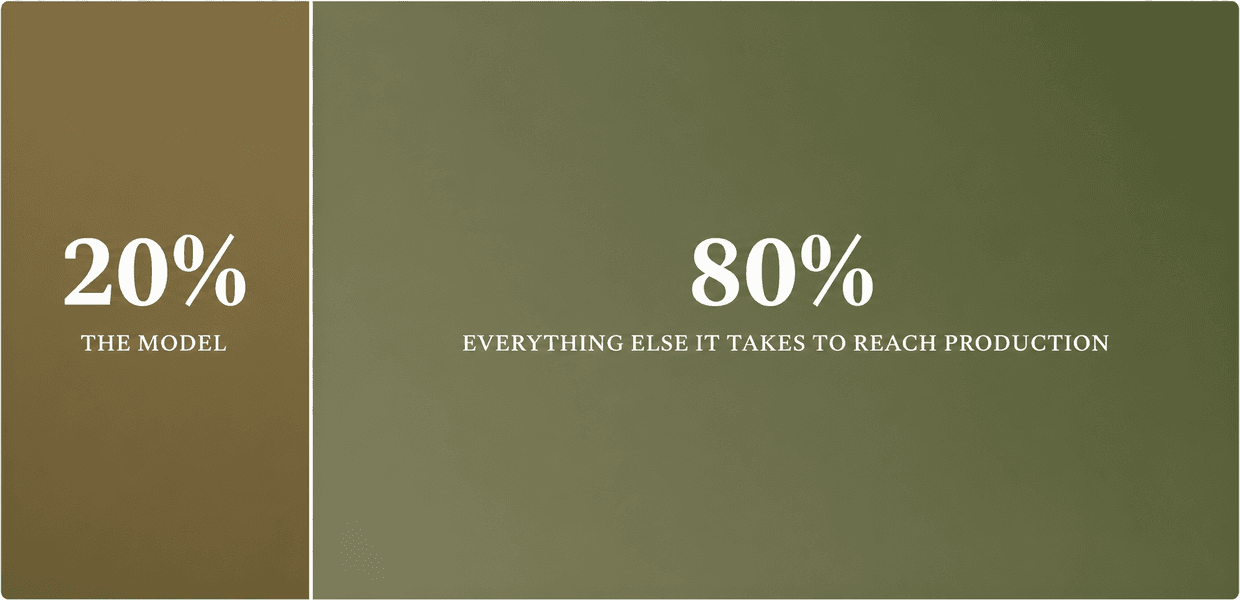
Most enterprise AI pilots fail before they start - not because the model is wrong, but because the infrastructure around it is. The 80/20 Rule explains what the model can't do, and how to close the gap.