
In this article
- Quick Answer
- Key Takeaways
- A digital labor strategy built on one horizontal AI platform — how AMN Healthcare is working toward an AI-Native enterprise.
- What operational challenges were you trying to solve when you set out to modernize AMN Healthcare's enterprise AI foundation?
- What would the cost to the business be if you didn’t solve for ROI first?
- How are AI agents being used across AMN Healthcare today?
- What's changing inside AMN Healthcare as you expand the use of AI and digital labor across the enterprise?
- What does an AI-native enterprise operating model look like — and is that where AMN Healthcare is headed?
- What would you tell other enterprise leaders who are earlier in their AI journey?
- How could an Enterprise Brain change the way employees interact with AI agents across AMN Healthcare?
Quick Answer
This is AMN Healthcare’s story: how the enterprise technology team is using AI and digital labor to transform high-volume workflows such as timesheet processing, billing reconciliation, and commission calculations, with the goal of reducing manual review and saving thousands of hours. Santosh Bhilegaonkar, Vice President of Enterprise Technology, describes ROI as the starting point for AI transformation: prioritizing measurable business outcomes, building shared ownership between business and IT, and moving beyond individual agents toward an Enterprise Brain that connects context, governance, and action across the enterprise.
key Takeaways
ROI has to come before scale. Santosh Bhilegaonkar’s approach starts with measurable business outcomes, not AI for AI’s sake. AMN Healthcare is prioritizing workflows where digital labor can reduce manual effort, improve efficiency, and ultimately contribute to EBITDA.
The opportunity is specific and measurable. Timesheet processing could save an estimated 1,200 hours per month, billing reconciliation around 180 hours per month, and commission processing could drop from 160–300 hours per cycle to 50–100. The goal is to move people out of repetitive review and into exception management.
Becoming AI-Native requires business and IT co-ownership. Technology alone cannot transform end-to-end operations. Business leaders need to define the outcomes, provide the context, and establish the KPIs, while IT provides the platform and execution layer. The longer-term vision is an Enterprise Brain that connects agents, systems, governance, and action into one experience.
A digital labor strategy built on one horizontal AI platform — how AMN Healthcare is working toward an AI-Native enterprise.
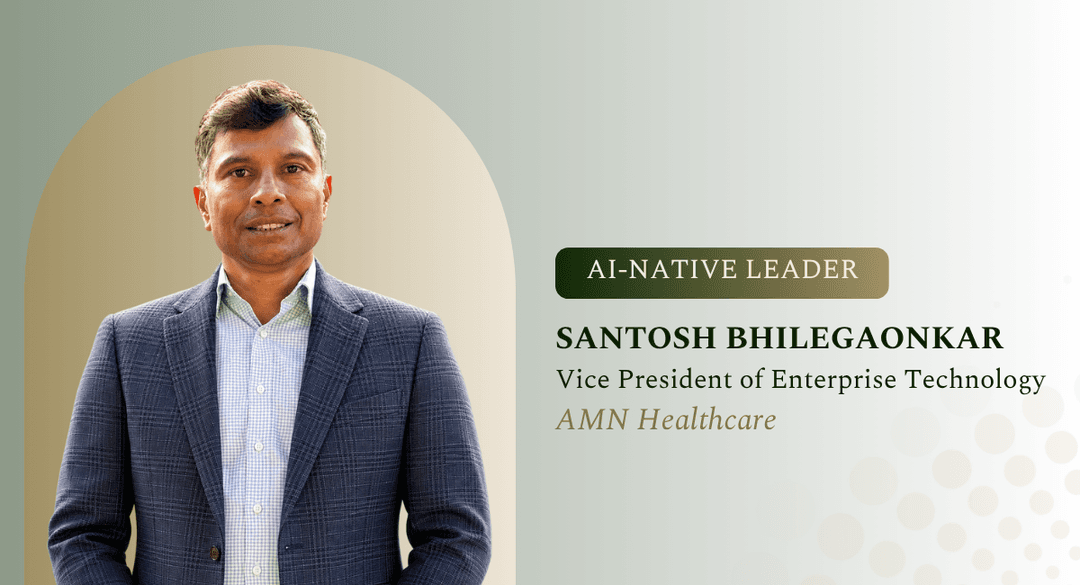
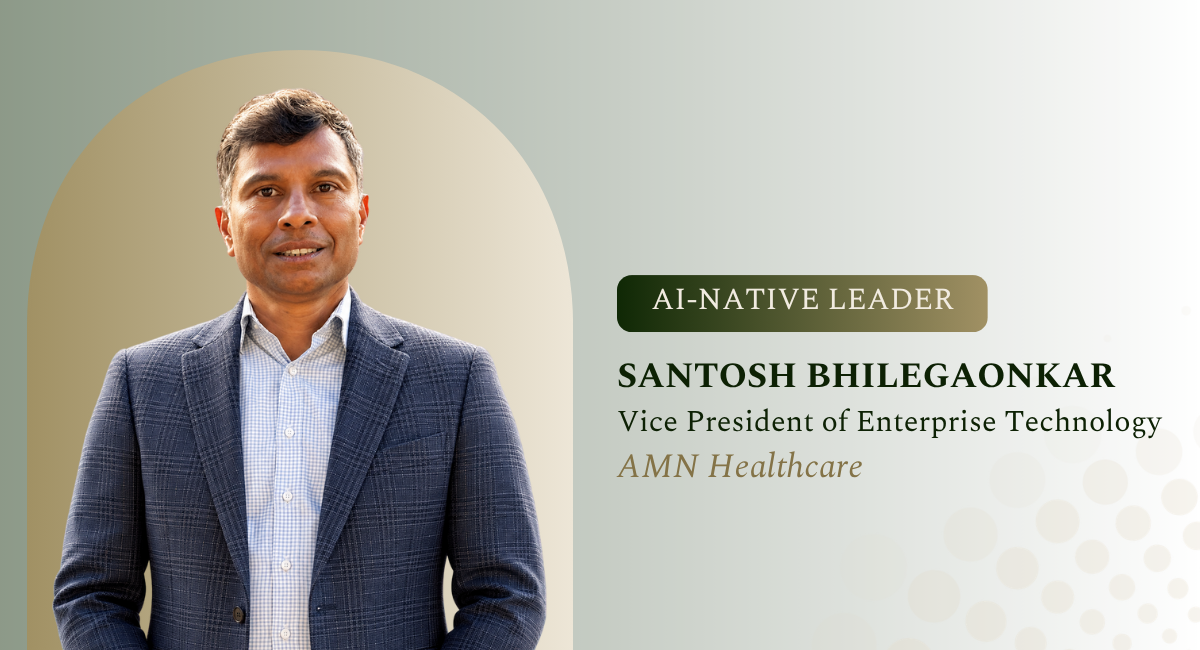
Excerpt from our conversation with Santosh Bhilegaonkar, Vice President of Enterprise Technology.
“We’re looking to transform entire workflows in ways that can drive much greater ROI, with humans in the loop.”
What operational challenges were you trying to solve when you set out to modernize AMN Healthcare's enterprise AI foundation?
The problem we're trying to solve is how to get ROI utilizing digital labor. Originally, I was solving for digital twins; now we're moving into digital labor — how do I get an ROI that drives EBITDA for our organization? We were looking for a platform that could connect end-to-end across all our systems of record, including custom applications, and help us build agents. That's when we found UnifyApps.
What would the cost to the business be if you didn’t solve for ROI first?
I'll give you an example: build versus buy. If I buy SaaS software, I have to customize it: there's an implementation cost, a SaaS cost, and a cost to customize it, and that still doesn't guarantee the outcome the business is looking for, because SaaS software is designed with a certain market in mind and isn't necessarily a fit for every market. With a platform, I can work with my team and build specifically what we want with no configuration cost, no migration cost.
How are AI agents being used across AMN Healthcare today?
AI is operational everywhere. We have agents writing software and doing quality work, and we have agents doing back-office work.
But we're still working toward really changing how we transform the complete operations of the business, which is more of a business transformation problem. We need business leaders involved, providing the context behind what they want to accomplish and how they want to transform the areas they manage. We’re still working through that.
The back-office AI work is particularly interesting. For timesheet processing across 10,000 employees per week, the target is to move from fully manual review to an exception-only model, reducing the volume requiring manual review to roughly 25–35% and saving an estimated 1,200 hours per month. Billing reconciliation across PeopleSoft and 32+ VMS platforms, currently reliant on Excel and VLOOKUP-based processes, will be automated through data normalization and an exception dashboard. The goal is to reduce manually reviewed rows up to 40% and save around 180 hours per month. Similarly, commission calculations that currently require 160–300 hours per cycle would potentially be reduced to 50–100 hours through AI-assisted processing. Beyond those three, the broader library of use cases spanning knowledge management, incident and change management, contract and accounts receivable agents, and candidate-facing tools like job search and profile completion, are all picking up momentum.
What's changing inside AMN Healthcare as you expand the use of AI and digital labor across the enterprise?
We're still early in the journey of developing and measuring ROI, but ultimately, this is an investment that needs to deliver a return.
We know the ROI of individual agents, but ultimately, we're looking to transform entire workflows in ways that can drive much greater ROI, with humans in the loop. We're looking at custom applications that have historically been heavily dependent on human labor and asking how we can transform them so that AI drives more of the work and humans manage the exceptions. That can create both hard and soft ROI.
What does an AI-native enterprise operating model look like — and is that where AMN Healthcare is headed?
Being an AI-Native enterprise is an aspiration for us, and some portions of the business are already moving in that direction. If you look at the way we develop software, for example, we're already using AI extensively. Our end-to-end processes aren't fully AI-Native yet, but that's where we're headed.
What would you tell other enterprise leaders who are earlier in their AI journey?
It takes discipline, commitment and business involvement. The success of an AI initiative—or a company's journey to becoming AI-Native—can't be driven by the IT organization alone.
You need clear business buy-in and commitment, along with KPIs from business leadership that define what success looks like for them. There needs to be co-ownership between the business and IT.
How could an Enterprise Brain change the way employees interact with AI agents across AMN Healthcare?
One of the concepts we really like at UnifyApps is the Enterprise Brain, which brings knowledge, governance and actionability into one shared enterprise context. Before Enterprise Brain, we had to think about deploying agents one at a time. It can determine which agents to call for a particular question or task, helping enable agent-to-agent communication and bringing those agents together.
The concept is that, based on a user's question, it knows where to redirect it and which agent to call. It concentrates and integrates our agents into one experience. It could become our search engine or a platform that we potentially provide to employees as an alternative to Copilot.
For the end user, it makes things much easier because they don't necessarily need to know which agent to use. Instead of looking through a set of agents and deciding, "I need to use this agent instead of that one," they can simply ask a question and the platform can figure out which agent to use.