

In this article
- Quick Answer
- Key Takeaways
- A look at how Brown University is approaching Agentic Automation with intention; starting with one use case where the operational need is greatest and building from there.
- What operational challenges were you trying to solve when you set out to modernize your enterprise AI foundation?
- Where has AI become operational across the organization, and where is it showing up most visibly?
- What has changed inside the organization since you began building this enterprise AI foundation?
- How do you think about the operating model of an AI‑native enterprise—and is that where you’re steering the organization?
- What would you tell other enterprise leaders who are earlier in their AI journey?
- What capability or outcome are you most excited to unlock next?
Quick Answer
This is Brown University's story: how the research administration and procurement teams cut Funding Opportunity Announcement review time from approximately one hour to 5–10 minutes, and meaningfully reduced contract queue times by starting with high-value, rules-based workflows instead of broad AI deployment. Bethany Warburton, Senior Project Manager in the Office of Information Technology, describes organizational readiness as equally critical as the technology: aligning stakeholders, understanding workflows deeply, and building frontline trust before automating anything.
key Takeaways
Organizational readiness determines whether AI delivers value or just adds complexity. Bethany Warburton's approach required getting the right stakeholders aligned, understanding the existing workflow before touching it, and building trust with the teams who would use the tools. The technology choices followed from that groundwork.
The result is specific and measurable. FOA review time cut from approximately one hour to 5–10 minutes. Contract queue times reduced significantly year over year. These are live outcomes from deployed workflows, not projections.
Start with rules-based, well-defined processes, not the most visible problems. Brown University chose contract management and FOA review because the rules were clear, the processes were well-defined, and the value was measurable. "Don't Pave the Cow Path": don't use AI to automate a broken or wasteful workflow.
AI projects don't close at go-live. Bethany Warburton's advice to other leaders: eliminate the go-live mindset. AI deployments are iterative, not sequential. As the technology advances, existing deployments need to evolve and the teams using them need channels to surface feedback fast.
A look at how Brown University is approaching Agentic Automation with intention; starting with one use case where the operational need is greatest and building from there.
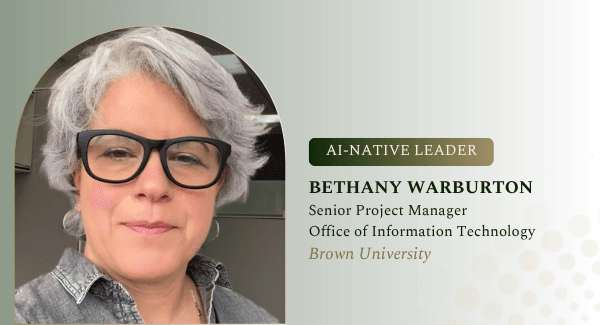
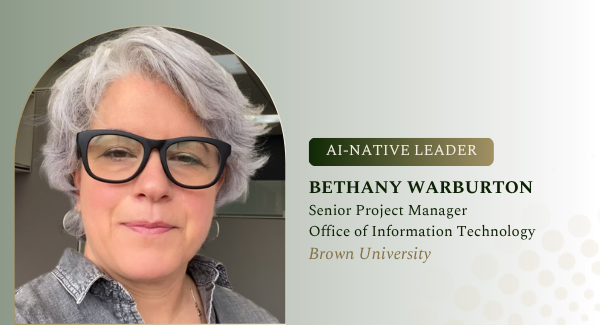
Excerpt from our conversation with Bethany Warburton, PMP , Sr. Project Manager , Office of Information Technology at Brown University.
"Don't Pave the Cow Path" — don't use AI to automate a broken, wasteful workflow. Take the time to re-engineer processes and do it right.
What operational challenges were you trying to solve when you set out to modernize your enterprise AI foundation?
As we look to meet budget constraints, our teams are being asked to do more with fewer resources. Introducing AI into our operations to help lift some of the effort from our team members makes so much sense, especially in areas where there is a lot of repetitive manual effort with data and rules/logic we can follow.
For us, that started with contract management and procurement operations. The team processes thousands of contracts and requisitions each fiscal year that require time-consuming validation checks across multiple stages of the contract lifecycle. The processes were rule-based and repetitive, which made them strong candidates for intelligent automation. The results have been a significant year-over-year reduction in queue time which moves contracts through the end-to-end process faster and with greater accuracy.
We also just went live with an AI solution for our research administration team for Funding Opportunity Announcements (FOA) where the technology is now parsing PDFs, cross-referencing checklists, allowing AI to extract structured data from FOA documents against a configurable checklist with citation references. The result has been to drop the review time from about 1 hour to 5–10 minutes per notice.
Overall, we are still in the very early stages and are monitoring everything closely to make sure our teams can really maximize the value. We expect to expand and will move with as much speed as makes sense for our departments.
Where has AI become operational across the organization, and where is it showing up most visibly?
Overall, we don’t expect any near-term deployments where our stakeholders internally will have high visibility into an AI specific solution. Rather, we hope it's pretty seamless to them and they just notice more efficiency and accuracy. For example, removing the bottlenecks from the data validation checks in the contracting processes has reduced queue times. Stakeholders aren’t interacting with the solution, but they are benefiting from it.
What has changed inside the organization since you began building this enterprise AI foundation?
What’s changed most is the awareness of the need to change. However, I think it's less because of the platform and more because of the realities of operating in the world right now. We have to work more efficiently and effectively and departments are becoming aware that there are tools that can help them.
We are looking to apply the lessons we’ve learned from these first few implementations, especially related to setting expectations with departments where readiness matters as much as technology. For example, getting the right stakeholders aligned, understanding the workflow before we look to automate it, and building trust with the teams who will use these tools is what best determines whether AI delivers value or just adds complexity. This groundwork makes everything else possible.
How do you think about the operating model of an AI‑native enterprise—and is that where you’re steering the organization?
We are exploring all mechanisms right now. I don’t think we’ll be early adopters of moving to a fully AI-native enterprise. But what we are focused on is making sure the foundation is right. That means starting with use cases where the rules are clear, the processes are well-defined, and the value is measurable. We are expanding thoughtfully, with as much speed as makes sense for our departments and stakeholders.
What would you tell other enterprise leaders who are earlier in their AI journey?
I just moderated a panel discussion on AI transformation and the following were some of my favorite insights shared:
"Don't Pave the Cow Path" — don't use AI to automate a broken, wasteful workflow. Take the time to re-engineer processes and do it right.
Create psychological safety to allow for "Shame-free Pivots." You want your team speaking up early and often about what isn't looking like it will hit the mark. Make sure there are immediate feedback channels to capture user feedback when the solution isn't aligning with their workflow - allowing the technical team to tweak or retrain the system quickly before users lose trust and abandon it.
Support your middle managers. They are bearing the heaviest burden in an AI transformation, squeezed between executive pressure and frontline panic.
“Eliminate the ‘Go-Live’ Mindset.” AI projects never truly close - they permanently alter the operating model. Success means leaving behind a highly predictable, sequential deployment, because AI deployments are iterative and as the technology advances, you will want to update existing deployments.
What capability or outcome are you most excited to unlock next?
Really, it's just about helping our operational frontline work more efficiently and effectively.
We know that the work we are doing has a compounding effect and each use case we automate frees up our team members to focus less on process administration and more on the work that requires their deep talent and expertise.
Now, we move to use case expansion. How can we evolve and iterate our current automations and expand impact, and where can we take the same approach we applied to contracting and research administration and apply it to other areas where automation can meaningfully impact the team. I think we are all excited about the returns we are seeing and what the future holds.