


The PII by UnifyApps node identifies and anonymizes personally identifiable information in text — names, numbers, account identifiers, and IDs — before it passes to downstream steps. Use it to protect sensitive data as it moves through an automation.
Overview
PII (Personally Identifiable Information) poses security vulnerabilities when stored or transmitted without protection. The PII by UnifyApps node uses AI to identify and mask sensitive data through anonymization.
The node recognizes bits of information from the given input text that can be particularly sensitive — names, numbers, accounts, IDs — and masks them by anonymizing the identified information before passing the result to downstream automation steps.
Actions Supported
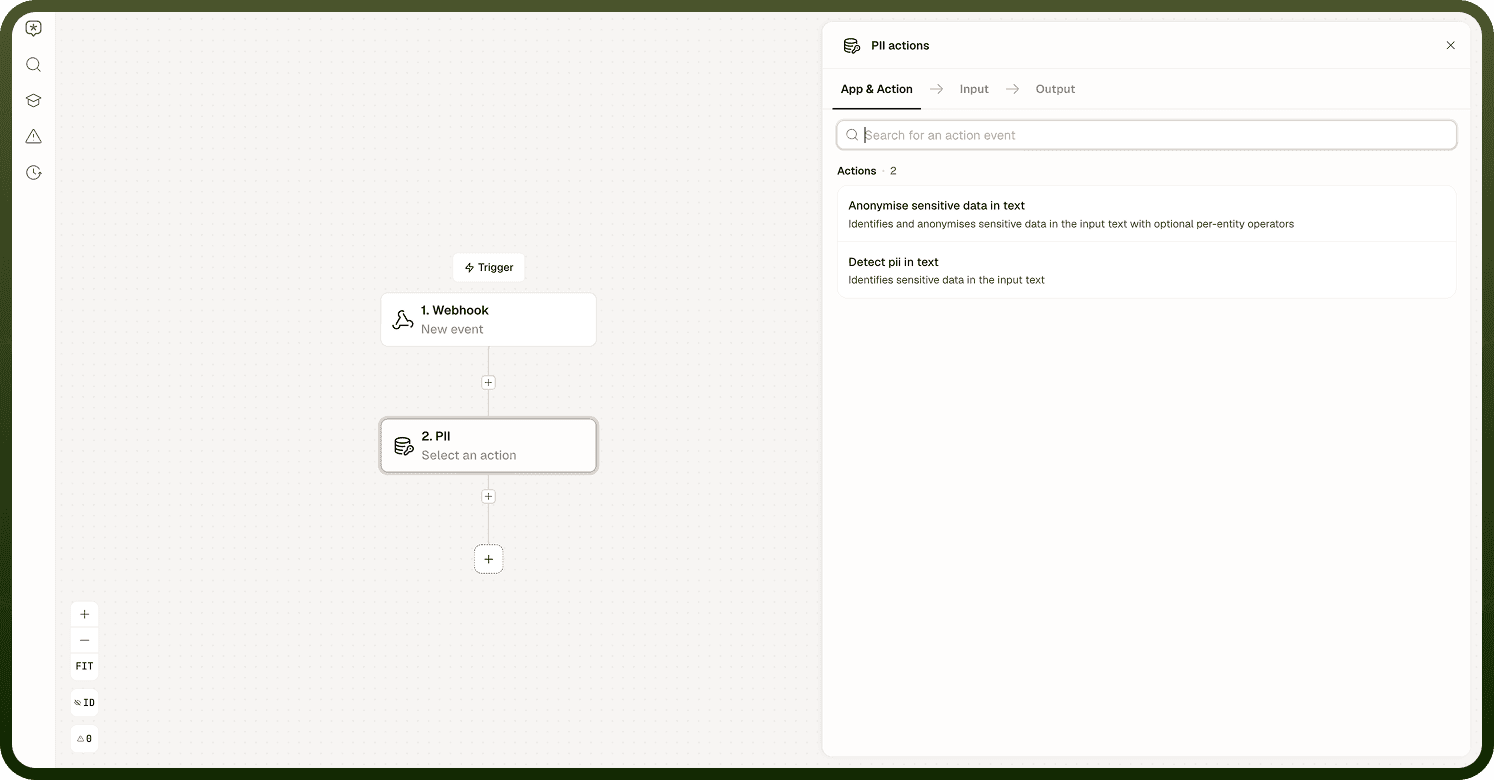
The PII by UnifyApps node exposes two actions:
Action | Description |
|---|---|
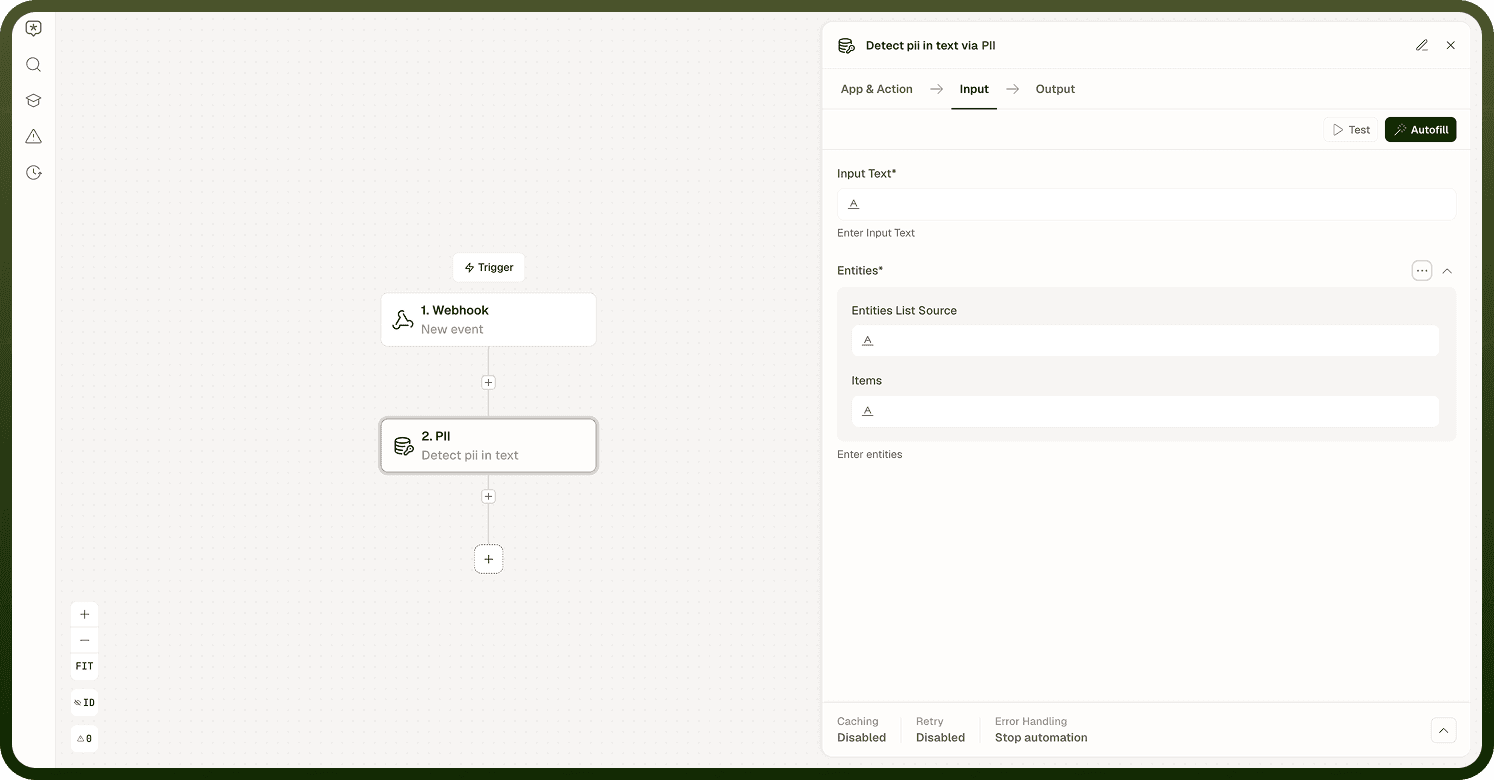
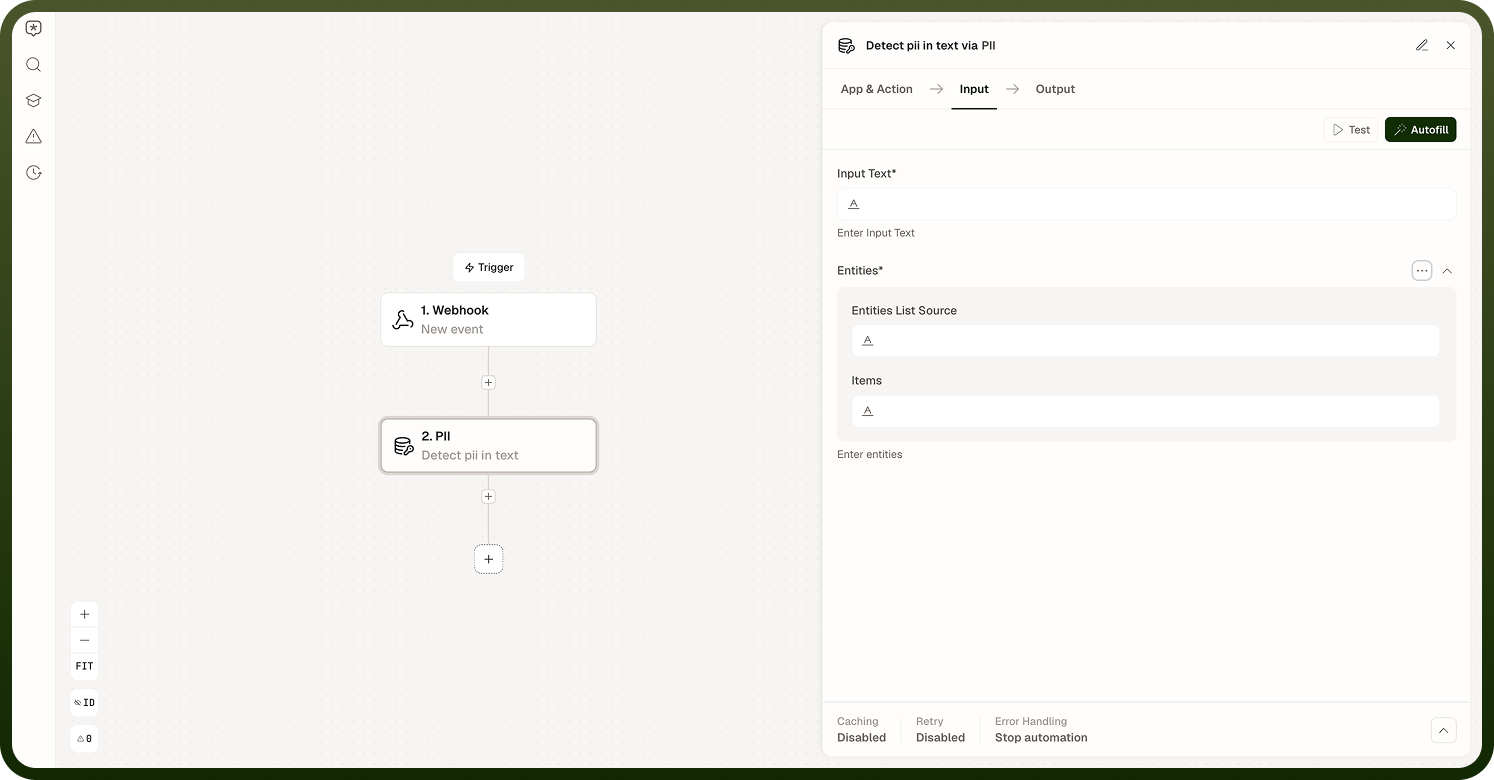
Detect PII in text | Identifies sensitive data in the input text and returns each detected entity, without changing the text itself. |
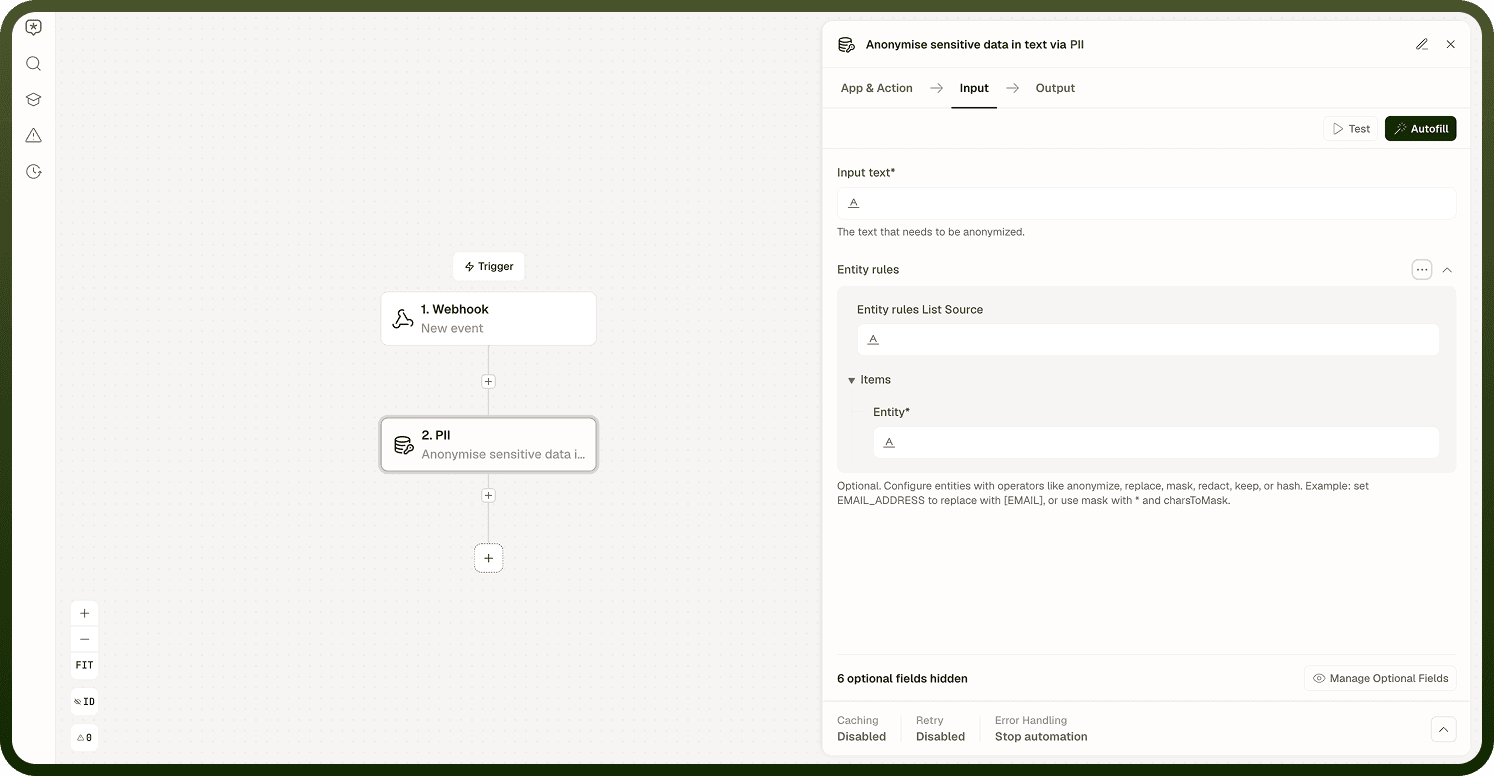
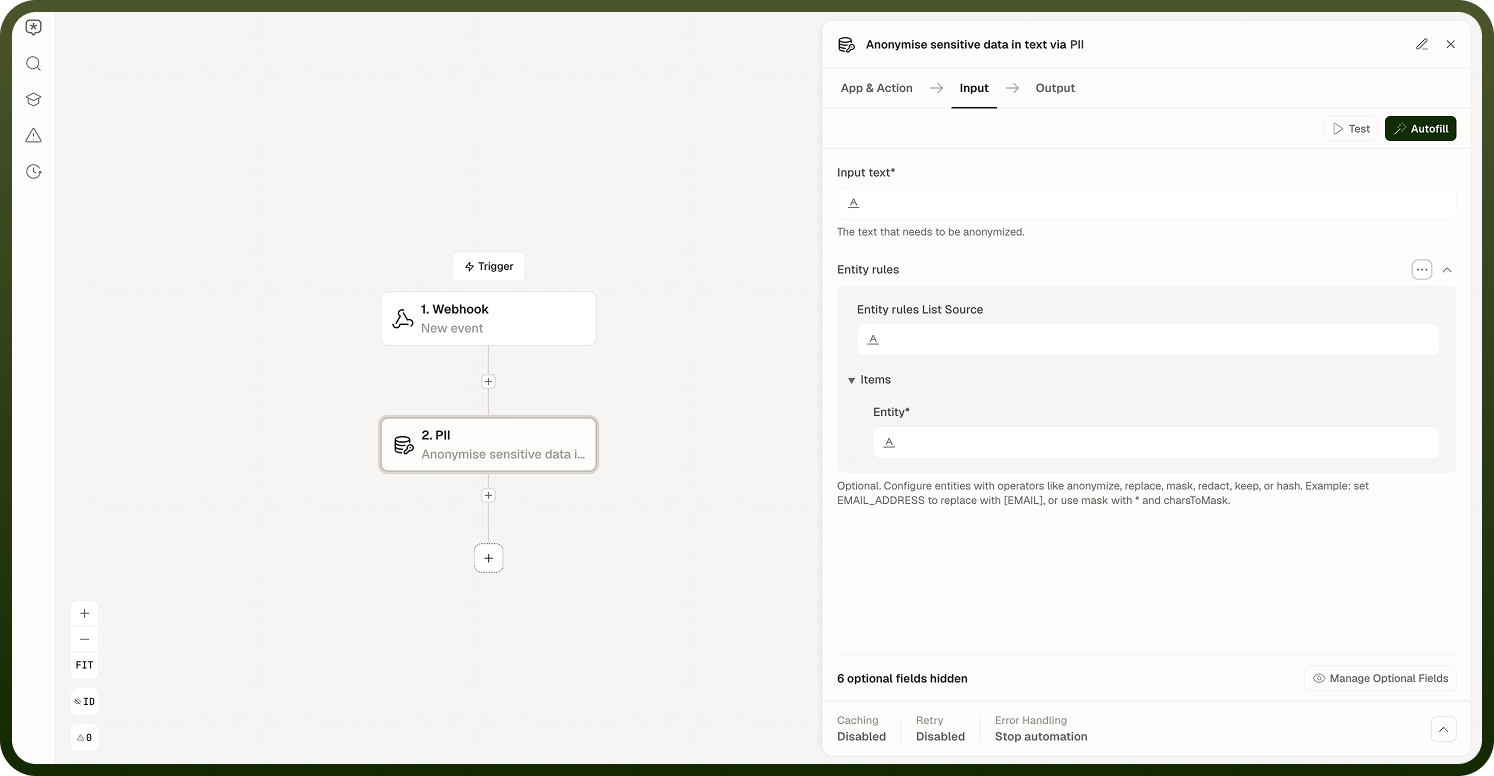
Anonymise sensitive data in text | Identifies sensitive data in the input text and anonymises it, with optional per-entity operators to control how each entity type is anonymised. |
Detect PII in text
This action takes an Input Text value and an Entities list, which restricts detection to specific entity types. Detection is machine-learning/named-entity based rather than simple pattern matching, so it can recognize entity types such as person names, email addresses, phone numbers, credit card numbers, and government-issued IDs.
Note: Detection currently targets English text only — other languages may detect poorly or not at all. It also uses a fixed set of built-in recognizers; you cannot add a custom detection pattern through this node.
Anonymise sensitive data in text
This action takes an Input text value and an optional list of Entity rules. Each rule applies to one entity type and sets an Operator that controls how matches of that type are anonymised — the operator defaults to anonymize if you don't set one. Supported operators and their parameters:
Operator | Description | Supported parameters |
|---|---|---|
anonymize (default) | Replaces the detected value with a generic placeholder for its entity type. | Entity, Operator |
replace | Replaces the detected value with a string you supply — for example, replacing an email address with [EMAIL]. | Entity, Operator, Replace value |
mask | Covers part of the detected value with a masking character. | Entity, Operator, Masking char, Chars to mask, Mask from end |
redact | Removes the detected value from the output text. | Entity, Operator |
hash | Replaces the detected value with a hashed representation. | Entity, Operator |
keep | Leaves the original value unchanged. | Entity, Operator |
An Advanced operator params field is also available on each entity rule for less common, operator-specific settings.
Use Case
A practical scenario involves creating a sample transaction database from Razorpay while protecting user data:
Fetch Account ID, Amount, Bank Details, and Email ID from Razorpay.
Input this data into PII by UnifyApps for masking.
Store the anonymized results in Google Sheets.
How to Mask Your Data
Identify the automation step that requires masking.
Add the "PII by UnifyApps" node and select "Anonymise sensitive data in text" as the action.
Enter the text or variables to mask in the input field.
Use the anonymized output as a data variable in downstream automation steps.
Notes
Keep these behaviors in mind when using the PII by UnifyApps node:
The node anonymizes detected PII in the text you supply — review its output in a test run before relying on it in a production pipeline that stores or transmits the result.
AI-based detection covers common PII categories (names, numbers, accounts, IDs) but may not catch every pattern in domain-specific or non-English text — audit the output for your specific data type.
Anonymization is not reversible within the automation — if you need the original values later in the same flow, store them in a Variable node before passing the text to this node.
Use this node as early in the flow as practical — masking upstream reduces the risk of PII appearing in intermediate logs or downstream node outputs.
Combine with the Logging node's field-masking feature for defense in depth: anonymize in the flow and mask in logs to prevent PII from appearing in either the data or the audit trail.
Placing the PII node as early as possible in the automation is the most effective way to limit sensitive data exposure across all downstream steps.