


Hooks in UnifyApps enable triggering child automations directly from existing nodes without requiring a separate node for this purpose.
Overview
Hooks in UnifyApps enable triggering child automations directly from existing nodes without requiring a separate node for this purpose. This feature simplifies workflow design by reducing redundancy while enhancing automation flexibility. Hooks can trigger any automation with a Callable via automation trigger type. Hooks are configured at the node level by enabling the hooks toggle in the node's extended menu.
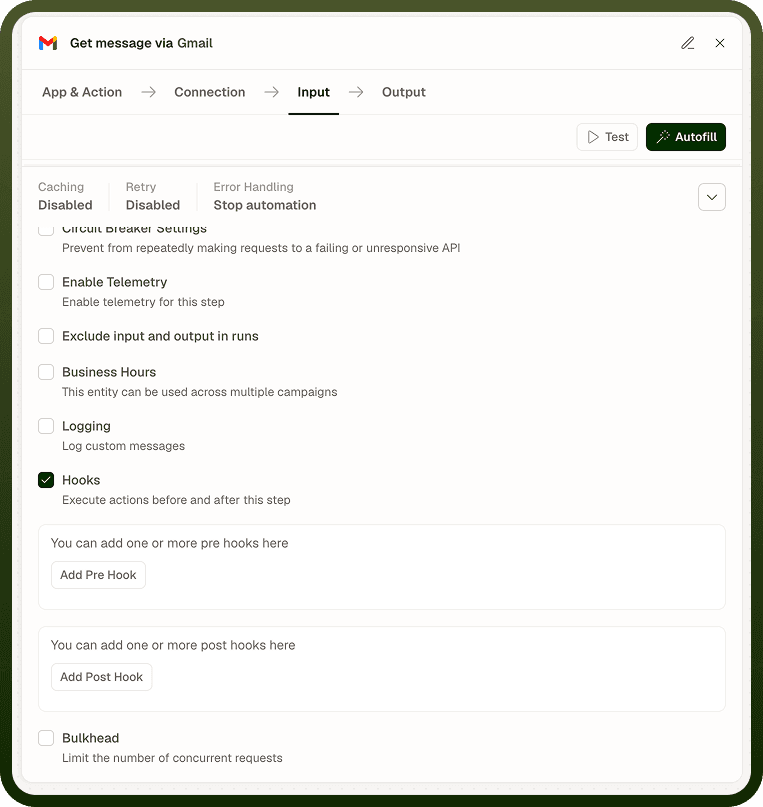
Understanding Hooks in Nodes
The platform supports two hook types at specific execution stages:
Pre-Hook — Triggers the specified automation before the node's execution begins.
Post-Hook — Triggers the specified automation after the node's execution completes.
Both hooks operate synchronously, meaning subsequent workflow events proceed only after the referenced automation finishes execution.
Failure Handling
Referenced automations triggered by hooks can be configured to allow node execution regardless of automation failure. This behavior is controlled via a checkbox in the hook configuration modal for both pre-hooks and post-hooks.
Setup Process
Select the target automation from a dropdown menu.
Input fields from the selected automation appear below for data mapping.
Use the checkbox to determine if the node continues regardless of referenced automation success or failure.
This approach ensures robust workflow execution with seamless automation integration.
Notes
Keep the following in mind when using Hooks:
Configure the “continue on failure” checkbox explicitly for each hook; the default behavior may not match your intent and differs between pre-hooks and post-hooks.
Pre-hooks run synchronously before the node executes; if the pre-hook automation fails and “continue on failure” is not enabled, the parent node will not run.
Use post-hooks for notification or audit actions that should fire after a node completes, regardless of downstream results.
The referenced automation must have a Callable via automation trigger and must be deployed before the hook can invoke it.
Test hooks in isolation by triggering the parent automation with controlled input before integrating hooks into a complex multi-step flow.