


Delay pauses an automation for an amount of time you set before continuing to the next step. Use it to space out actions — wait before a follow-up email, hold between retries, or stagger calls to a rate-limited app. You pick a duration and a unit (seconds, minutes, hours, days), and the run resumes automatically when the time is up.
Overview
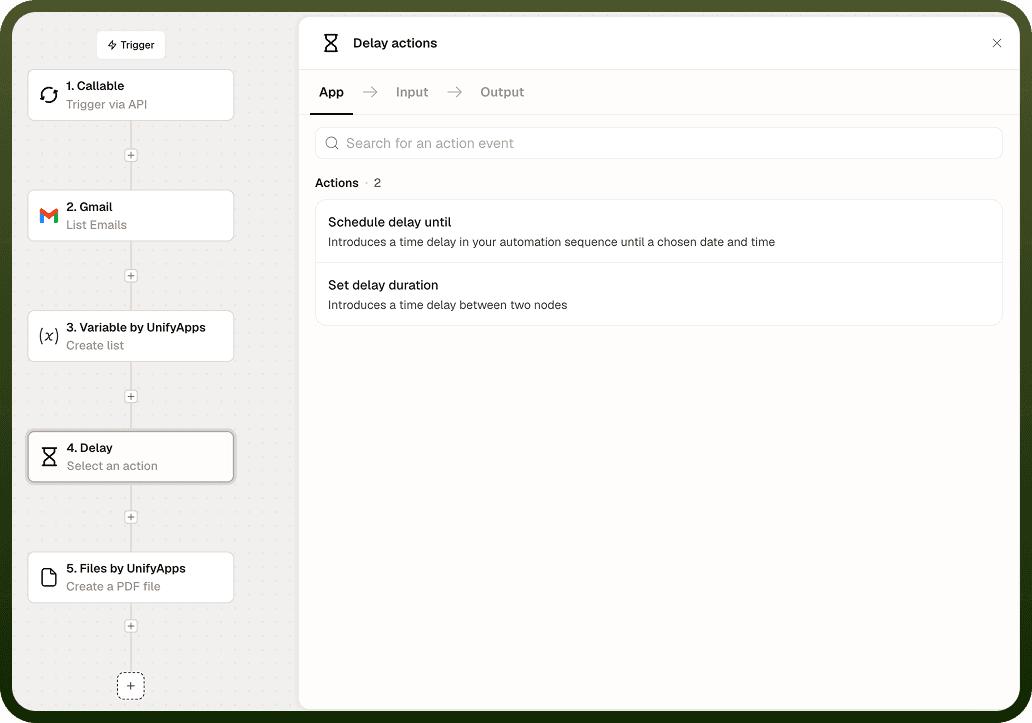
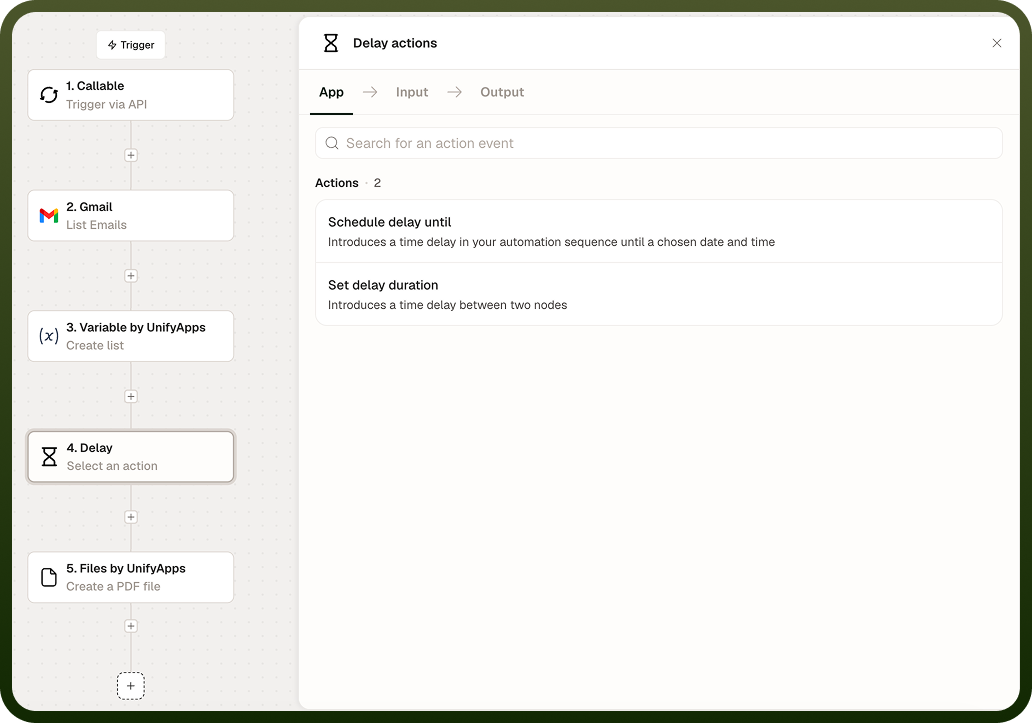
The Delay node manages timing within automation workflows by introducing a pause at a chosen point. You can delay until a specific date and time, or for a set duration between actions. The pause is fully managed by the platform — you do not need to handle scheduling or state yourself.
How the Delay Works
The Delay is asynchronous — a waiting automation does not tie up a worker thread the whole time. The platform handles short and long waits differently:
Short delay (about 10 seconds or less) — held in memory and resumes almost immediately when the timer expires.
Longer delay — the run's state is persisted and scheduled: the automation is saved to durable storage and woken up later when the time arrives.
This means a multi-hour or multi-day Delay is safe to use. It survives service restarts, does not consume a running thread while it waits, and resumes exactly where it left off. You can confidently build "wait 3 days, then follow up" automations without worrying about resource exhaustion or dropped state.
Long delays are durable: Once a run enters a long Delay, its state is written to persistent storage. A service restart or deployment during the wait does not lose the run — it will resume when the scheduled time arrives.
Delay node — short vs. long delay behavior and durable state persistence
Use Case Example
Two primary applications:
Schedule Delay Until — Scheduled customer follow-ups: when a lead reaches a certain sales pipeline stage, pause the automation until a specific follow-up date, then send an outreach message at precisely the right time.
Set Delay Duration — Staggered marketing campaign launch: introduce timed gaps between campaign rollouts across channels to optimize reach without overwhelming audiences.
Actions in Delay
Schedule Delay Until — Pauses the automation until a specified date and time. Use this when the next action needs to happen at a known future moment — for example, sending a reminder exactly 24 hours after a form submission, or triggering a campaign on a scheduled launch date.
Delay node Schedule Delay Until — date and time picker for a future timestamp
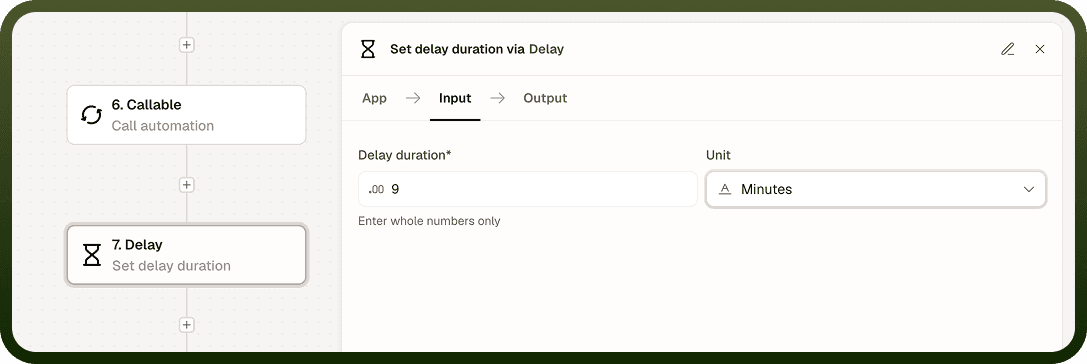
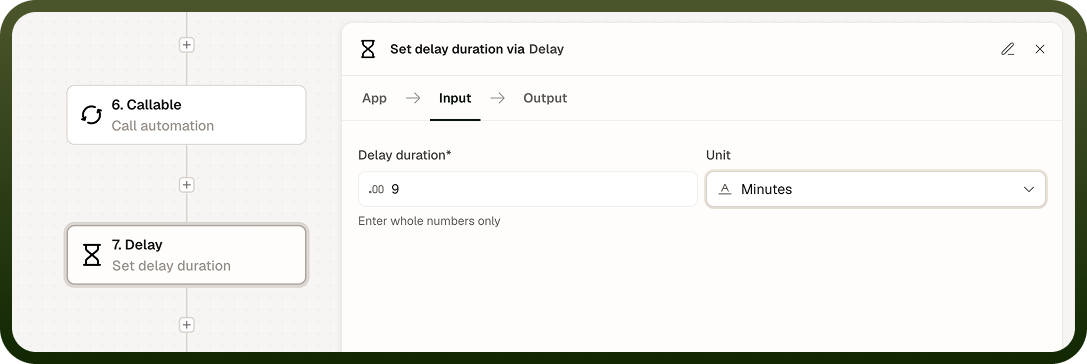
Set Delay Duration — Introduces a fixed interval between actions. You choose a number and a unit (seconds, minutes, hours, or days). Use this when you need a relative pause rather than an absolute point in time — for example, waiting 30 minutes between retry attempts, or spacing out API calls to stay within rate limits.
Delay node Set Delay Duration — duration amount and unit selection fields
Notes
Keep the following in mind when using the Delay node.
The Delay is asynchronous — waiting runs do not hold a worker thread open. You can use long delays freely without worrying about resource exhaustion.
Short delays (roughly 10 seconds or less) are held in memory; longer delays are persisted to durable storage and scheduled for later resumption.
Persisted delays survive service restarts and deployments — the run will resume correctly when the scheduled time arrives.
Multi-hour and multi-day delays are fully supported; "wait 3 days, then check again" automations are a safe and intended use case.
Use Schedule Delay Until when the resume time is a known future date or timestamp; use Set Delay Duration when the pause is relative to when the run arrives at the node.
If your automation involves several long delays in sequence, test the full run end-to-end before deploying to confirm each segment resumes and passes data correctly.