


Feature Flags are on/off switches for platform capabilities, backed by System environment variables, that let you turn capabilities on or off from one place.
Overview
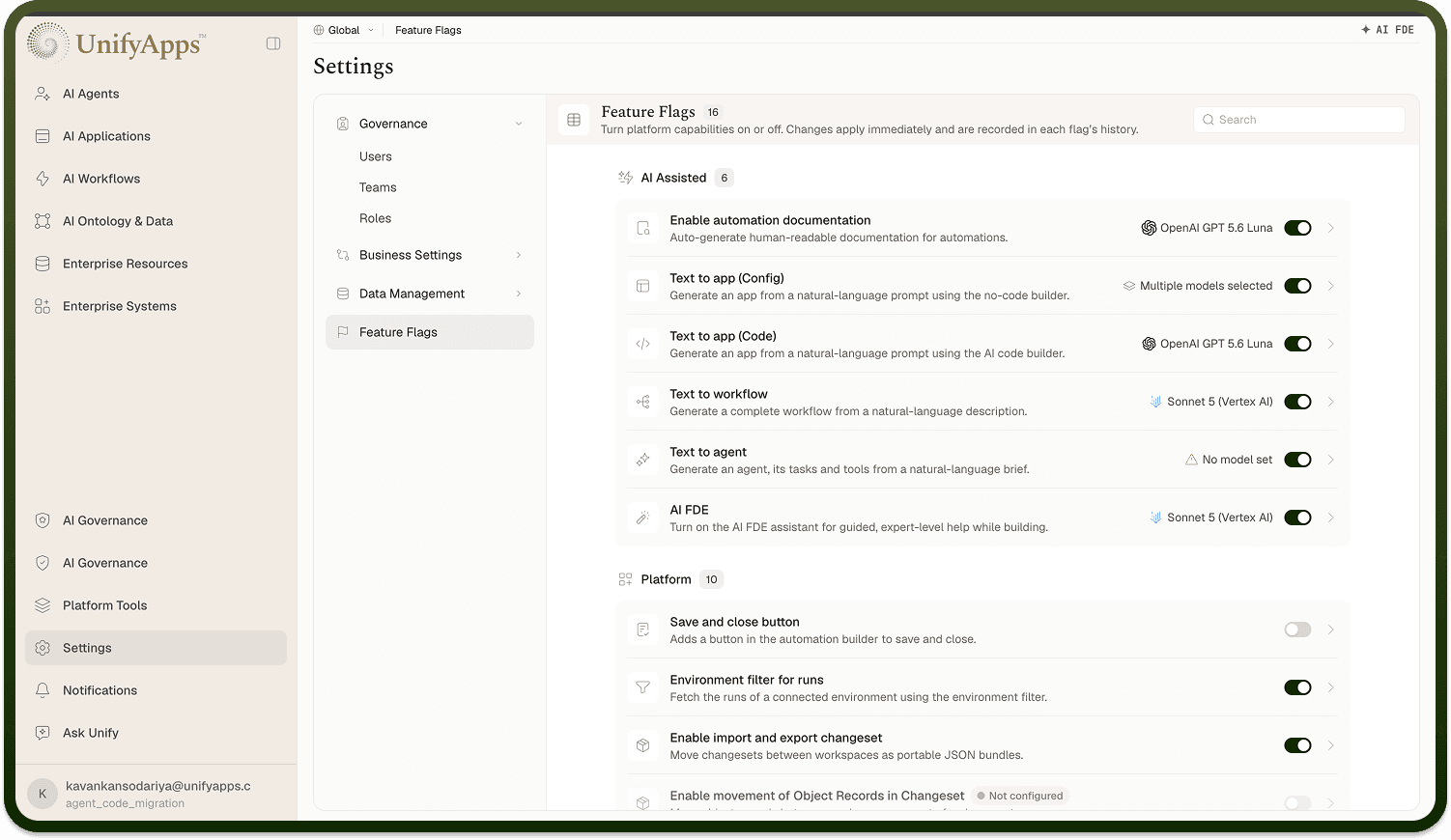
Feature Flags is a settings screen whose subtitle sums it up: "Turn platform capabilities on or off. Changes apply immediately and are recorded in each flag's history." Each flag is a labeled row with an icon, a short description of what it does, and a toggle. The screen is a friendlier view over a curated set of System (standard) environment variables — the boolean switches the platform reads to enable or disable features — so you don't have to find and edit those variables by hand. A search box filters the list, and a count pill shows how many flags exist.
Use Cases
Turn on an AI-assisted capability, such as generating an application, workflow, or agent from a natural-language prompt.
Toggle general platform behaviors like change-set import/export or interface collaboration.
Decide whether new environment variables start out sensitive and masked by default, using the "Default sensitive value" flag.
Audit who changed a capability and when, using each flag's history.
Manage platform capabilities from labeled toggles instead of hunting through raw environment variables.
Turning a Feature On or Off
Flip the flag's toggle. Changes apply immediately — there's no separate save step. The toggle updates optimistically and confirms with "Changes saved"; if the save fails, it reverts and shows "Couldn't save changes." Because a flag maps to a System environment variable that platform features read, turning it on or off changes how the platform behaves for the workspace right away — for example, enabling an AI generation capability or interface collaboration.
How Flags Are Organized
Flags are grouped by area:
AI Assisted — capabilities powered by AI, such as generating an application, workflow, or agent from a natural-language prompt (for example, "Text to application" — "Generate a complete interface from a natural-language prompt").
Platform — general platform behaviors, such as change-set import/export, interface collaboration, and "Default sensitive value" ("Treat new values as sensitive by default so they are masked") — the flag that decides whether new environment variables start out sensitive.
Use search to jump straight to a flag by name.
Reading a Flag's Status
Instead of a toggle, a row can show a status pill:
No access — you don't have read permission for that flag's underlying variable, so its current state can't be shown to you.
Not configured — the flag's environment variable doesn't exist in this workspace yet, so there's nothing to switch.
If the whole screen can't load state, it shows "We couldn't read the current on/off state of these features." If a workspace exposes no flags at all, you'll see "No features to show" — "This workspace doesn't expose any feature flags yet."
Viewing a Flag's Change History
Each flag has a "View history" action (the clock icon) that opens a day-grouped timeline of changes. Entries are labeled Created, Updated, Turned on, or Turned off, each with who made the change — a specific user or System. If there's nothing yet, it reads "No changes recorded yet."; a load failure shows "Couldn't load change history." This history is the audit trail for the flag's underlying environment variable, so it's also where you see the change log for that variable.
Relationship to Environment Variables
A feature flag is a System environment variable — a boolean one the platform ships and reads to switch a capability. Feature Flags simply presents the important ones as labeled toggles with descriptions and history, while the same variables also appear on the System tab of Environment Variables. Reaching this screen needs the same permission that unlocks that System tab. Flip a flag here or change the System variable's value there — it's the same underlying setting.
Notes
Use search or the count pill to confirm you're looking at the flag you expect before assuming it's missing.
Treat "Not configured" as a signal to check with an admin, not a bug — the underlying variable simply doesn't exist yet in the workspace.
Remember toggles apply immediately with no save step, so confirm the impact before flipping a capability that affects the whole workspace.
Check a flag's "View history" before assuming who last changed it — entries record the specific user or System.
Know that flipping a flag here is identical to editing its System environment variable directly, so pick whichever surface is more convenient for the task at hand.