


Overview
A Request Transformer Policy allows you to modify incoming API requests before they are forwarded to the backend service. It enables dynamic transformation of request data such as headers, query parameters, and body content.
This policy is useful for enforcing standards, enriching requests, removing unnecessary data, or adapting client requests to match backend requirements without changing the client or service implementation.
Field Reference | Description |
| A unique identifier for the policy, used across logs, dashboards, and API group configurations. Required |
| Custom labels to organize and filter the policy by environment, team, or functionality. Optional |
| Specifies the request protocols for which this policy is applied (e.g., HTTP, HTTPS). Only requests matching the selected protocols will trigger this policy. Required |
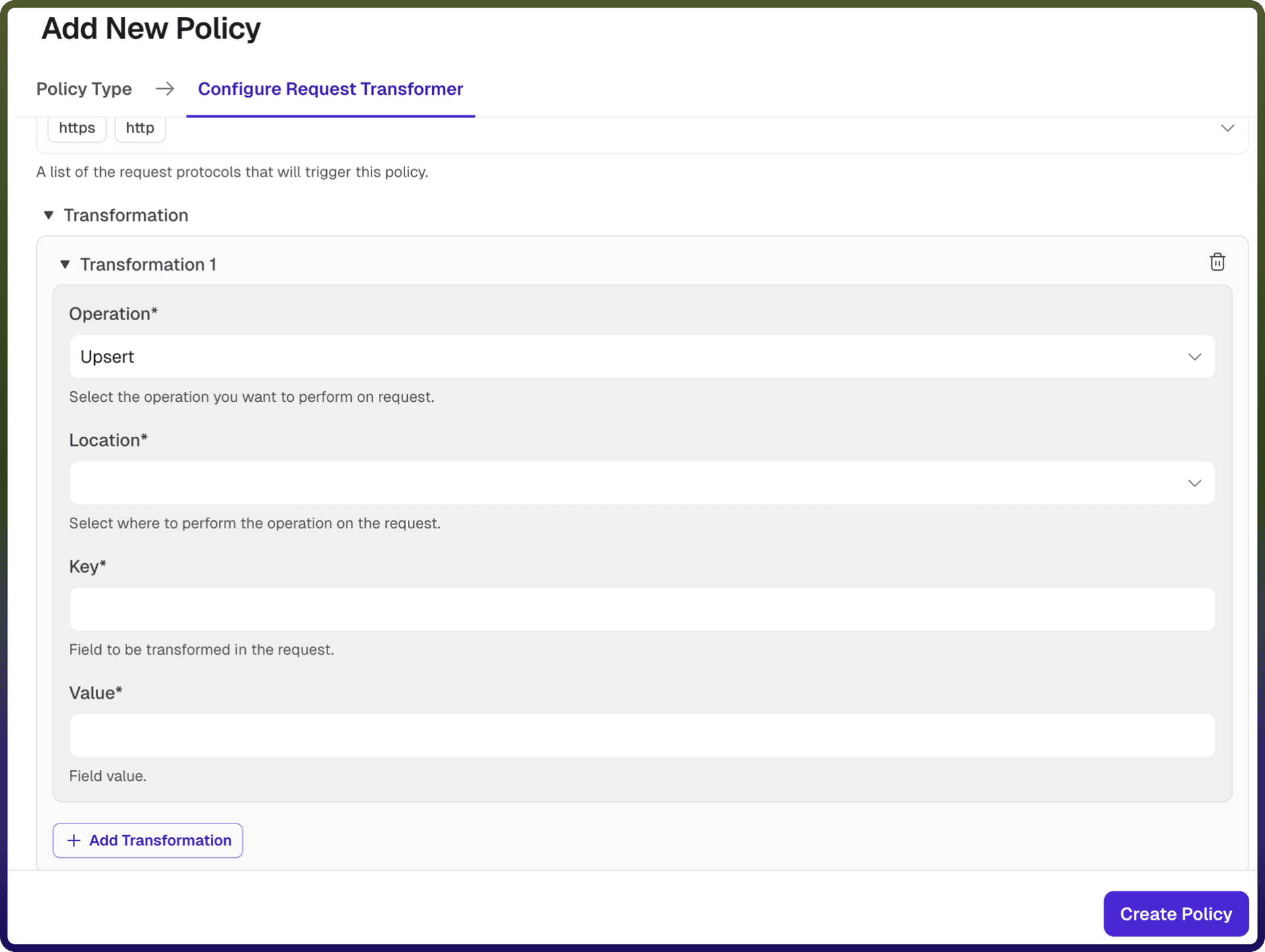
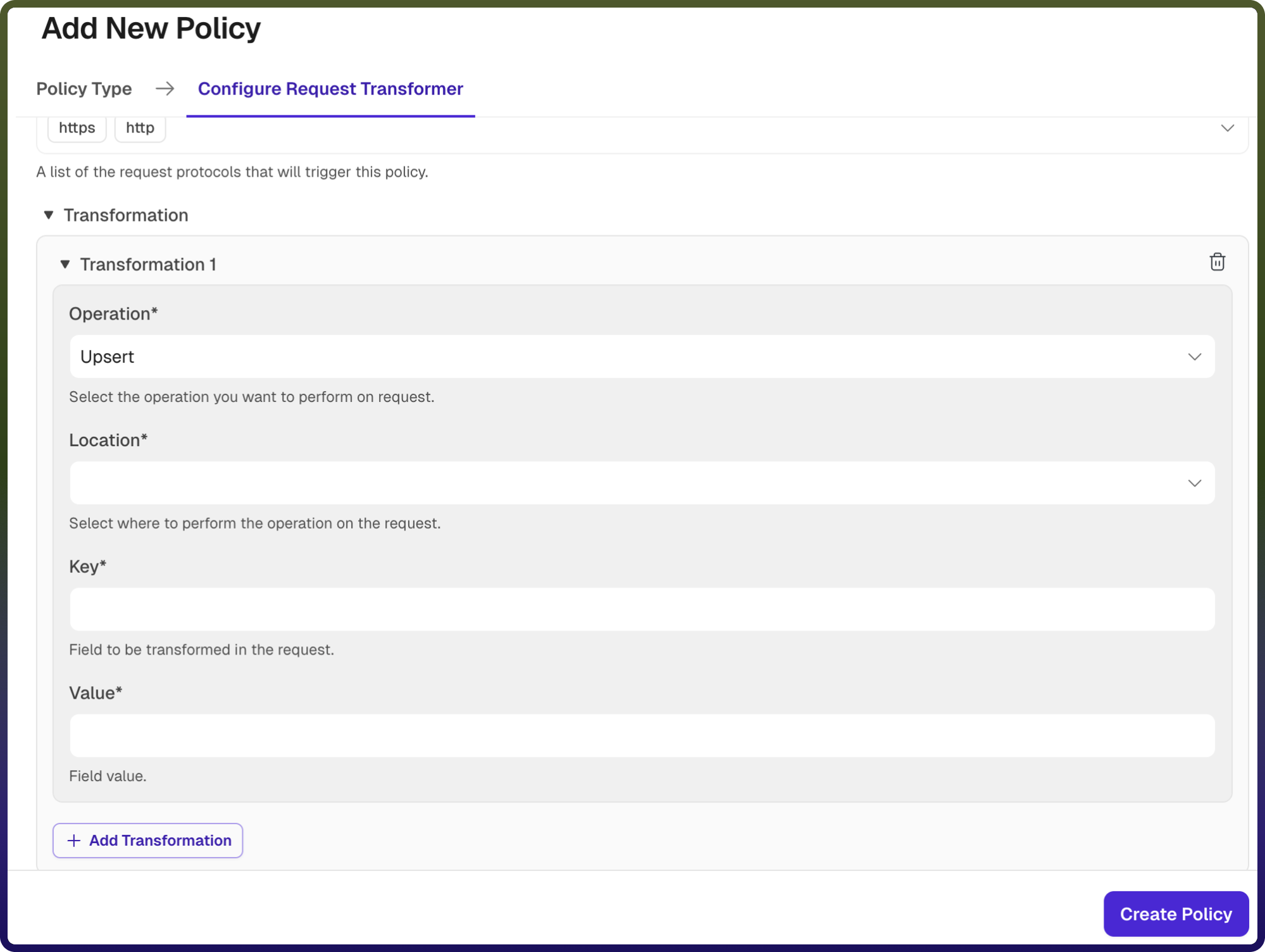
| Defines one or more transformation rules to be applied to the response. Each rule contains Operation, Location, Key, and Value. |
| Specifies the type of transformation to perform. Required Supported operations include: → Upsert: Adds a new field or updates it if it already exists → Remove: Deletes a field from the response → Rename: Renames an existing field → Replace: Replaces the value of an existing field |
| Specifies where the transformation should be applied in the response: → Header: Modify HTTP response headers → Body: Modify the response payload Required |
| Defines the field name (key) to be transformed. → For Header, this refers to the header name → For Body, this refers to the field in the response payload Required |
| Defines the value or expression to be applied during the transformation. → For Upsert/Replace, this is the new value → For Rename, this is the new key name → For Remove, this may specify the field to be removed Required |
How It Works
Request received:The gateway receives an incoming API request.Policy evaluation: The request is checked against the configured protocols to determine if the policy applies.Transformation execution: Each transformation rule is applied in sequence:Fields may be added, updated, renamed, replaced, or removed
Transformations are applied to headers, query parameters, or body as configured
Modified request forwarded: After all transformations are applied, the updated request is forwarded to the backend service.
Attaching a Policy to an API Group
Once a Request Transformer Policy is created, it can be attached to one or more API Groups. Multiple policies can be applied to an API Group, and their execution order can be configured by arranging them in the desired sequence.