


Use the Dappier connector to deliver AI-powered content experiences.
Integrating your application with Dappier lets you use these operations in an automation. It exposes 5 actions, listed below. Add the connector from the Connections area, authenticate, then select its operations in the automation builder. Capabilities: actions.
Authentication
Before you begin, make sure you have the following information:
Connection Name: Choose a meaningful name for your connection. This name helps you identify the connection within your application or integration settings.
Authentication Type: The authentication method for this connector is defined in the connection setup. Select the connector in the Connections area to see the fields it requires.
Obtaining Your API Key
Go to the Dappier platform at platform.dappier.com and sign up, or log in if you already have an account.
Click your profile menu and select Settings.
In Settings, open the Profile tab.
Click API Keys.
Click to generate a new API key.
Copy the generated key and store it securely for further authentication purposes.
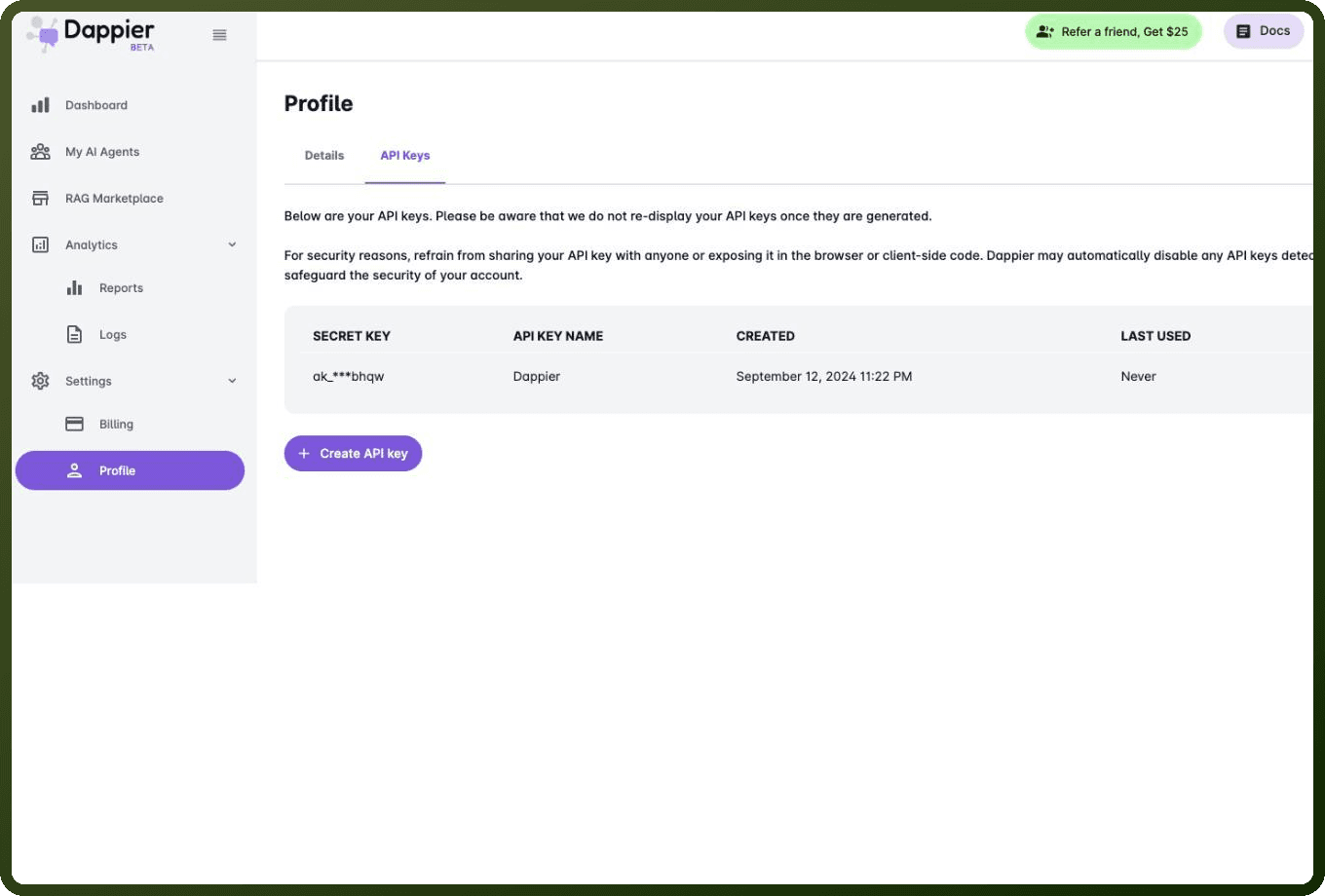
Authentication & setup
Dappier uses Bearer Token authentication. Navigate to your account settings and generate an API key from the API Keys section. Include the key in the Authorization header as Bearer {api_key} with each request.
Actions
Action Name | Description |
|---|---|
Get lifestyle articles | Gets lifestyle articles in Dappier |
Get real time data | Gets real-time data in Dappier |
Get sports articles | Gets sport articles in Dappier |
Get stock market data | Gets stock market data in Dappier |
Send prompt | Sends a prompt to Dappier |
About the API
Dappier is a Retrieval-Augmented Generation (RAG) API marketplace designed to supercharge your AI applications with real-time, trusted data. It reduces AI hallucinations by providing access to real-time data from trusted sources. The platform is LLM-agnostic and integrates with any AI system without requiring model retraining.
Core offerings include:
RAG model marketplace with selectable models
Real-time search capabilities
AI-powered recommendation widgets
Embeddable chatbot widgets
Third-party integrations
Content monetization through pay-per-query or revenue-sharing models